Gender and contemporary risk of adverse events in atrial fibrillation
European Heart Journal


Abstract
The role of gender in decision-making for oral anticoagulation in patients with atrial fibrillation (AF) remains controversial.
The population cohort study used electronic healthcare records of 16 587 749 patients from UK primary care (2005–2020). Primary (composite of all-cause mortality, ischaemic stroke, or arterial thromboembolism) and secondary outcomes were analysed using Cox hazard ratios (HR), adjusted for age, socioeconomic status, and comorbidities.
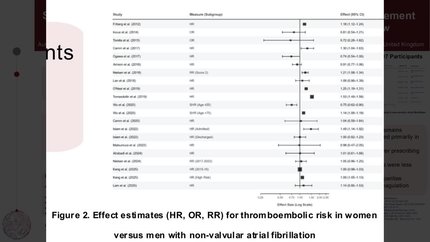
78 852 patients were included with AF, aged 40–75 years, no prior stroke, and no prescription of oral anticoagulants. 28 590 (36.3%) were women, and 50 262 (63.7%) men. Median age was 65.7 years (interquartile range 58.5–70.9), with women being older and having other differences in comorbidities. During a total follow-up of 431 086 patient-years, women had a lower adjusted primary outcome rate with HR 0.89 vs. men (95% confidence interval [CI] 0.87–0.92;
Removal of gender from clinical risk scoring could simplify the approach to which patients with AF should be offered oral anticoagulation.
Contributors

Asgher Champsi
Author
Alastair R Mobley
Author
Anuradhaa Subramanian
Author
Krishnarajah Nirantharakumar
Author
Xiaoxia Wang
Author
David Shukla
Author
Karina V Bunting
Author
Inge Molgaard
Author
Jeremy Dwight
Author
Ruben Casado Arroyo
Author

Harry J G M Crijns
Author
Cardiovascular Research Institute Maastricht (CARIM) Maastricht , Netherlands (The)
Luigina Guasti
Author


R Thomas Lumbers
Author
Barts Heart Centre London , United Kingdom of Great Britain & Northern Ireland
Bart Maesen
Author

Emma Svennberg
Author
Otilia Țica
Author

Stylianos Tzeis
Author


Dipak Kotecha
Author
University of Birmingham Birmingham , United Kingdom of Great Britain & Northern Ireland
You may be interested in