Atlas of interventional cardiology 2023: European Society of Cardiology and European Association of Percutaneous Coronary Interventions
European Heart Journal


Abstract
This study aims to provide the most comprehensive assessment to date of interventional cardiology practices across European Society of Cardiology (ESC) national society member countries, with a focus on infrastructure, procedural volumes, temporal trends (2013–22), regional disparities, and adherence to guideline-recommended care.
The third edition of the ESC–European Association of Percutaneous Cardiovascular Interventions Atlas presents data from 50 ESC national society member countries, collected through a dedicated 2023 survey of national cardiac societies and interventional working groups. Data were subjected to a rigorous multi-step quality control process to ensure consistency and accuracy. Key metrics include interventional resources, such as the number of hospitals with catheterization laboratories, trained personnel, and the proportion of women in the interventional workforce; procedural volumes and types, including percutaneous coronary intervention (PCI), primary PCI, transcatheter aortic valve implantation, transcatheter mitral valve procedures, transcatheter tricuspid valve procedures; and procedural characteristics, including arterial access site, use of intracoronary imaging, physiological lesion assessment, and sex-specific data on patient care delivery.
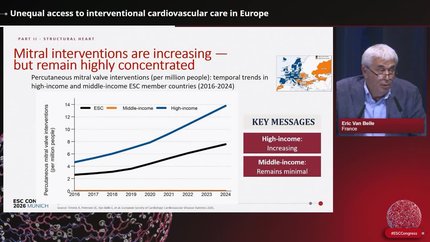
Despite the ongoing expansion of structural heart transcatheter interventions, PCI remains the dominant procedure, accounting for >90% of all percutaneous cardiovascular interventions. Percutaneous coronary intervention volumes showed limited variation across ESC member countries and demonstrated no significant association with gross national income per capita. In contrast, important regional disparities were observed in the use of transcatheter aortic valve implantation, transcatheter mitral valve procedures, and transcatheter tricuspid valve procedures with procedure rates strongly correlated with gross national income (
The third edition of the ESC–European Association of Percutaneous Cardiovascular Interventions Atlas highlights significant progress in percutaneous cardiovascular interventions across Europe but also underscores persistent disparities. These findings reinforce the need for balanced investment strategies, harmonized training, greater sex equity, and enhanced data infrastructures to support more equitable and evidence-based cardiovascular care.
Contributors



Valeria Paradies
Author


Ignacio Cruz-Gonzalez
Author
Georgios Triantis
Author

Raban Jeger
Author
Ahmed Magdy
Author

Rickard Linder
Author

Hanna Tormilainen
Author
Denis Kazakiewicz
Author
Radu Huculeci
Author
Nick Townsend
Author

Steffen E Petersen
Author
Queen Mary University of London London , United Kingdom of Great Britain & Northern Ireland
Adam Timmis
Author
Panos Vardas
Author
Martine Gilard
Author
Alaide Chieffo
Author


You may be interested in