Estimated annual healthcare costs after acute pulmonary embolism: results from a prospective multicentre cohort study
European Heart Journal - Quality of Care and Clinical Outcomes


Abstract
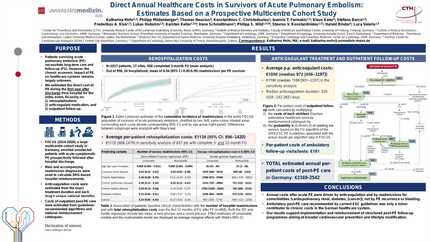
Patients surviving acute pulmonary embolism (PE) necessitate long-term treatment and follow-up. We estimated, the chronic economic impact of PE on the German healthcare system.
We calculated the direct cost of illness during the first year after discharge for the index PE, analysing data from a multicentre prospective cohort study in Germany. Main and accompanying readmission diagnoses were used to calculate DRG-based hospital reimbursements; anticoagulation costs were estimated from the exact treatment duration and each drug's unique national identifier; and outpatient post-PE care costs from guidelines-recommended algorithms and national reimbursement catalogues. Of 1017 patients enrolled at 17 centres, 958 (94%) completed ≥3-month follow-up; of those, 24% were rehospitalized (0.34 [95% CI 0.30–0.39] readmissions per PE survivor). Age, coronary artery, pulmonary and kidney disease, diabetes, and (in the sensitivity analysis of 837 patients with complete 12-month follow-up) cancer, but not recurrent PE, were independent cost predictors by hurdle gamma regression accounting for zero readmissions. The estimated rehospitalization cost was €1138 (95% CI 896–1420) per patient. Anticoagulation duration was 329 (IQR 142–365) days, with estimated average per-patient costs of €1050 (median 972; IQR 458–1197); costs of scheduled ambulatory follow-up visits amounted to €181. Total estimated direct per-patient costs during the first year after PE ranged from €2369 (primary analysis) to €2542 (sensitivity analysis).
By estimating per-patient costs and identifying cost drivers of post-PE care, our study may inform decisions concerning implementation and reimbursement of follow-up programmes aiming at improved cardiovascular prevention.
Contributors

Katharina Mohr
Author
Philipp Mildenberger
Author
Thomas Neusius
Author
Konstantinos C Christodoulou
Author

Klaus Kaier
Author

Frederikus A Klok
Author

Karsten Keller
Author
Dorothea Becker
Author
Christina Abele
Author
Leonhard Bruch
Author
Ralf Ewert
Author
Irene Schmidtmann
Author
Philipp S Wild
Author
Stephan Rosenkranz
Author

Stavros V Konstantinides
Author
University Medical Centre of the Johannes Gutenberg University Mainz , Germany
Harald Binder
Author

Stefano Barco
Author
Dorothea Becker
Author
Brunhilde Fischer
Author
Lukas Hobohm
Author
Anja Käberich
Author
Karsten Keller
Author
Frederikus A Klok
Author
Stavros V Konstantinides
Author
Nadine Martin
Author
Anna C Mavromanoli
Author
Silke Otto
Author
Kai-Helge Schmidt
Author
Luca Valerio
Author
Philipp S Wild
Author
Leonhard Bruch
Author
Stefanie Geistert
Author
Katrin Schüler
Author
Ralf Ewert
Author
Claudia Pohl
Author
Jeannette Pieper
Author
Martin Faehling
Author
Birgit Blaich
Author
Annika Landmesser
Author
Stephan Rosenkranz
Author
Felix Gerhardt
Author
Jasmin Rudolph
Author
Sibel Gün
Author
Hossein-Ardeschir Ghofrani
Author
Ute George
Author
Ekkehard Grünig
Author
Benjamin Egenlauf
Author
Amina Salkić
Author
Eva-Maria Heier
Author
Michael Halank
Author
Kristin Tausche
Author
Tina Rink
Author
Diana Jäkel
Author
Matthias Held
Author
Barbara Schröder
Author
Marius M Hoeper
Author
Julia Freise
Author
Susanne Tayler
Author
Hanno H Leuchte
Author
Annika Horn
Author
F Joachim Meyer
Author
Dagmar Emge-Rossa
Author
Karine Thabaret
Author
Claus Neurohr
Author
Juergen Barton
Author
Christian Opitz
Author
Ines Bressem
Author
Hans-Jürgen Seyfarth
Author
Patricia Berger
Author
Angela Hennig
Author
Rolf Wachter
Author
Kristian Hellenkamp
Author
Carmen Sentler
Author
Martina Schulte
Author
Heinrike Wilkens
Author
Franziska Trudzinski
Author
Ines Holtz
Author
Eckhard Mayer
Author
David Fistera
Author
Aleksandar Grgic
Author
You may be interested in