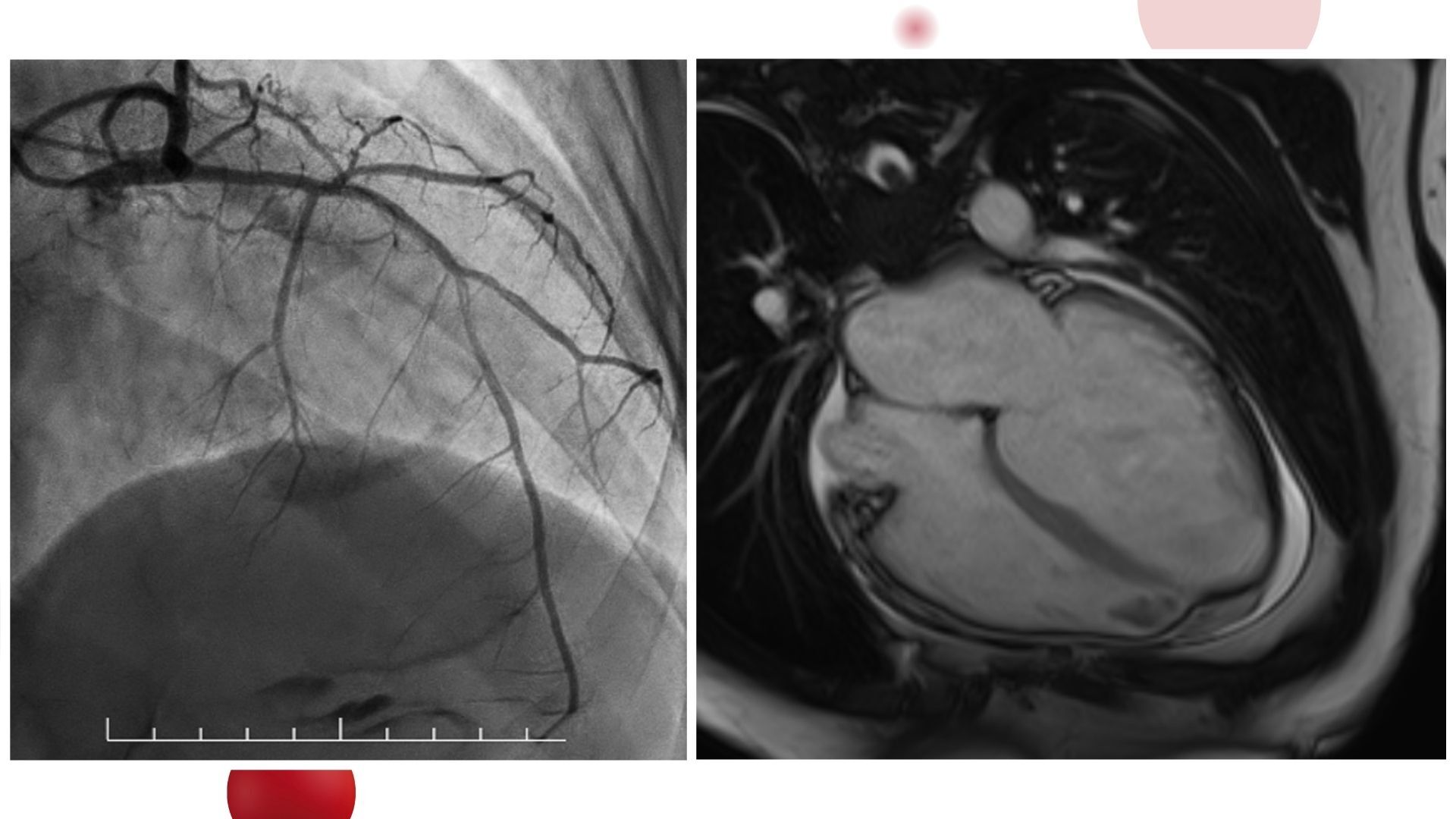

61 year-old male with Partial Anomalous Pulmonary Venous Return (PAPVR)

15 October 2017
Organised by: Logo
Practice Tools Open Access Test your knowledge

The case

Description:

  • A male patient (61 years old, non-smoker, BMI 24.8 kg/m2) has a history of congenital corvitium, type Partial Anomalous Pulmonary Venous Return (PAPVR) and patent foramen ovale (PFO).
  • He contacted us for a diagnostic work-up of reduced exercise tolerance and exercise-induced dyspnea (NYHA II) of unknown origin.
  • He takes no medication.
  • His baseline clinical examination is normal.
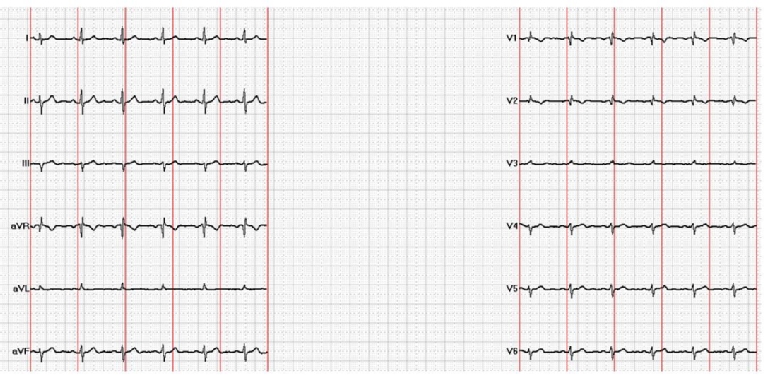
  • The baseline electrocardiogram is shown in Figure 1.
  • His N-Terminal pro-B type natriuretic peptide (NT-pro BNP) level was 124 pg/ml.

CPX-Quiz-Oct-2017-Fig1-ECG_escardio-hPhotoLarge.jpg

Test findings:

  • Pulmonary function test (PFT) was performed: Forced Vital Capacity (FVC): 82% predicted, Forced Expiratory Volume in 1 second (FEV1): 80% predicted. FEV1/FVC ratio > 70%.
  • The resting transthoracic echocardiography shows a non-hypertrofied, non-dilated left ventricle (LV) with a normal EF (68%).
  • The right ventricle (RV) is lightly to moderately dilated (Basal RV D: 4.1 cm, Mid RV D: 4.0 cm, Base-to-apex RV D: 8.8 cm, RV/LV basal D: 1.0), with a normal RV systolic function (RV FAC: 52%, RV S’ 10 cm/sec, TAPSE 24 mm) and no resting pulmonary hypertension (PAPm rest: 14 mmHg).
  • There is a 40% left-to-right shunt fraction (Qp/Qs: 1.4).

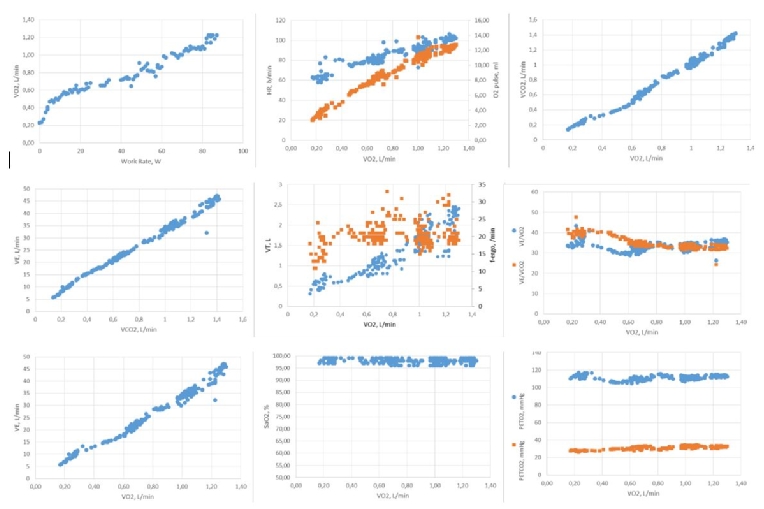
We subsequently performed a combined exercise echocardiography and cardiopulmonary exercise test in order to investigate the cause of the patient’s main complaint. The main results of the cardiopulmonary exercise test are summarised in Table 1, those of the exercise echocardiographic examination in Table 2.

  • This test was terminated due to leg fatigue.
  • There was no evidence of arrhythmia and/or ECG changes suggestive of ischemia during the test.
  • The systolic blood pressure increased normally.
  • The Oxygen Pulse (πO2) showed an initial increase in a hyperbolical fashion, followed by a slow approach to an asymptotic value (i.e. no πO2 flattening and/or decline) during exercise.
Table 1. Cardiopulmonary exercise test results
Parameter Measured Value
RER max 1.03
HR peak (% pred) 72
VE peak/MVV < 80%
VO2 peak (% pred) 51
VT1 (% VO2 max pred) > 40
OUES (ml/min/log[ml/min]) 1537
OUES (% pred) 65
VE/VCO2 slope 30
VE/VCO2 slope at VT1 31
∆ VO2/∆W 10, no slope flattening
∆SaO2 < 4%

RER: Respiratory Exchange Ratio; HR: Heart Rate; VE: Minute Ventilation; MVV: Maximal Voluntary Ventilation; VO2: Oxygen consumption; VT1: First Ventilatory Threshold; OUES: Oxygen Uptake Efficiency Slope; W: Load.

9-panel-plot-CPX-Oct2017_escardio-hPhotoLarge.jpg

Table 2. Exercise echocardiography test results
Parameter Resting value Low intensity High intensity
Load (W) 0 25 83
PAPs (mmHg) 20 30 40
PAPm (mmHg) 14 20 26
RV FAC (%) 52 56 62
RV S’ (cm/sec) 10 12 18
PAPm/CO slope     2.74
PAPs/W slope     0.23
RVESPAR ratio     2.75
LV EF (%) 68 72 74
E/E’ 7.5 7.0 8.1

W: Watt; PAPs: systolic pulmonary artery pressure; mPAP: mean pulmonary artery pressure; RV: right ventricle; FAC: fractional area change; CO: cardiac output; RVESPAR: right ventricular end-systolic pressure area relation; EF: ejection fraction; LV: left ventricle.


References

Suggested reading

  • Obokata M, Kane GC, Reddy YN, Olson TP, Melenovsky V, Borlaug BA. Role of Diastolic Stress Testing in the Evaluation for Heart Failure With Preserved Ejection Fraction: A Simultaneous Invasive-Echocardiographic Study. Circulation 2017;135(9):825-838.
  • Bandera F, Generati G, Pellegrino M, Donghi V, Alfonzetti E, Gaeta M, Villani S, Guazzi M. Role of right ventricle and dynamic pulmonary hypertension on determining ΔVO2/ΔWork Rate flattening: insights from cardiopulmonary exercise test combined with exercise echocardiography. Circ Heart Fail 2014;7(5):782-90.

Contributors

ESC 365 is supported by