Sex differences in dual antiplatelet therapy de-escalation strategies after percutaneous coronary intervention: a network meta-analysis
European Heart Journal


Abstract
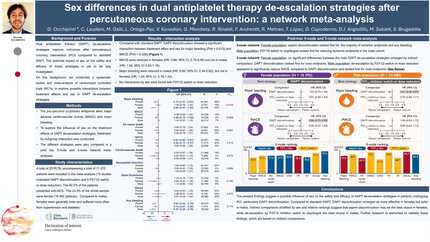
Dual antiplatelet therapy (DAPT) de-escalation strategies improve outcomes after percutaneous coronary intervention (PCI) compared to standard DAPT. However, the potential impact of sex on the safety and efficacy of these strategies is yet to be fully investigated.
Randomized controlled trials comparing de-escalated vs standard DAPT regimens in patients without baseline indication for oral anticoagulation reporting outcomes stratified by sex were included. The co-primary endpoints were trial-defined major adverse cardiovascular events (MACE) and major bleeding. Hazard ratios (HR) with 95% confidence intervals (CI) were computed to account for different follow-up durations. A network meta-analysis including ranking of treatments was performed to explore the comparative effects of different DAPT de-escalation strategies among females and males.
Overall, 71 272 patients from 20 trials were included, and 23.3% were female. De-escalation strategies were grouped into (1) DAPT discontinuation, by aspirin or the P2Y12 inhibitor; or (2) P2Y12 inhibitor switch or dose reduction. With DAPT discontinuation vs standard DAPT, a significant interaction between treatment effect and sex was found for both MACE (
Sex may influence the safety and efficacy of antiplatelet de-escalation strategies after PCI, particularly those involving the shortening of DAPT. Aspirin discontinuation may represent the optimal strategy for females, while P2Y12 inhibitor switch to clopidogrel may be most effective for males.
Contributors


Claudio Laudani
Author

Luis Ortega-Paz
Author
Vijay Kunadian
Author


Roxana Mehran
Author
Teresa López-Sobrino
Author

Dominick J Angiolillo
Author
Manel Sabaté Tenas
Author
Salvatore Brugaletta
Author
You may be interested in