Transient ST-segment elevation during stress echocardiography: coronary anatomic, functional, and prognostic correlates
European Heart Journal


Abstract
Inducible ST-segment depression during stress echocardiography (SE) is associated with a higher risk in patients with inducible regional wall motion abnormality (RWMA).
To assess ST segment elevation's prevalence and functional correlates during SE.
ECG response was analyzed in 1712 patients (age 63±12 years; 1011 men, 59%) undergoing SE for chronic coronary syndromes (CCS) prospectively recruited at 39 laboratories. Among the patients analyzed, 1286 (75%) performed SE with exercise, 306 (18%) with dobutamine and 120 (7%) with a vasodilator. ECG response was considered abnormal in case of ST-segment shift >1.0 mm from baseline at 80 ms from the J point developed in ≥2 contiguous leads during SE. The stress to rest (∆) change in the wall motion score index (WMSI) was assessed in all patients. Coronary angiography was available in 765 patients. Major adverse cardiac events (MACE) were the outcome measure in 746 patients with follow-up information.
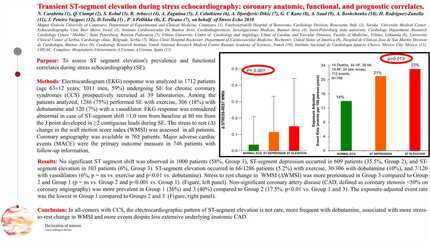
No significant ST segment shift was observed in 1000 patients (58%, Group 1), ST-segment depression occurred in 609 patients (35.5%, Group 2), and ST-segment elevation in 103 patients (6%, Group 3). ST-segment elevation occurred in 66/1286 patients (5.2%) with exercise, 30/306 with dobutamine (10%), and 7/120 with vasodilators (6%, p = ns vs. exercise and p<0.01 vs. dobutamine). The prevalence of stress-induced RMWA was higher in Group 2 (38.1%) compared to Group 3 (33%) and Group 1 (11.9%. P< 0.001 vs. Groups 2 and 3); however, the ΔWMSI was more pronounced in Group 3 compared to Group 2 and Group 1 (p = ns vs. Group 2 and p<0.001 vs. Group 1). (Figure, left panel). Non-significant CAD (defined as coronary stenosis <50% on coronary angiography) was more prevalent in Group 1 (36%) and 3 (40%) compared to Group 2 (17.5%, p<0.01 vs. Group 1 and 3). . During a median follow-up of 387 days (IQ range 314-603 days), 150 events occurred in 112 patients: 14 all-cause deaths, 39 acute myocardial infarctions, 19 atrial fibrillations, 34 late coronary revascularizations, and 44 acute heart failure hospitalizations. The exposure-adjusted event rate was the lowest in Group 1 compared to Groups 2 and 3 (Figure, right panel).
In all-comers with CCS, the electrocardiographic pattern of ST-segment elevation is not rare, more frequent with dobutamine, associated with more stress-to-rest change in RWMA and more events despite less extensive underlying anatomic CAD. The paradox of more ischemia with less coronary stenosis is consistent with a coronary vasospastic origin as an important yet frequently overlooked cause of stress-induced ST segment elevation.
Contributors



J C Jelena Celutkiene
Author


A B Alla Boshchenko
Author
Tomsk National Research Medical Center of the Russian Academy of Sciences Tomsk , Russian Federation
H R Hugo Rodriguez-Zanella
Author


E P Eugenio Picano
Author
Clinical center of Serbia and School of medicine University of Belgrade Belgrade , Serbia
You may be interested in