Chronotropic incompetence during exercise or pharmacological stress is associated with survival in patients with chronic coronary syndromes
European Heart Journal


Abstract
Chronotropic incompetence (CI) is a biomarker of cardiac autonomic dysfunction.
To assess the risk stratification value of CI during physical or pharmacological stress echocardiography in patients with chronic coronary syndromes.
In a prospective, multicenter, international, observational study design, we enrolled 13,445 patients with known or suspected chronic coronary syndromes who underwent stress echo in 19 sites from 10 countries using either exercise (n=2,594), dobutamine (n=2,440), or dipyridamole (n=8,411). Heart rate was automatically measured from the 1-lead ECG in the echo monitor. We considered CI as failure to reach 85% of the maximal predicted (220-age) heart rate for exercise and dobutamine, and heart rate reserve (peak/rest heart rate) <1.22 (<1.17 in permanent atrial fibrillation) for dipyridamole. All-cause death was the outcome measure.
Heart rate reserve was available in all patients; there was no extra imaging or analysis time, and no intra- and inter-observer variability. CI was observed in 5,045 patients (38%); abnormal regional wall motion abnormality in 1,648 (13%). Over a median follow-up time of 3.5 years, there were 2,426 (18%) deaths. The 10-year mortality was 39% in patients with and 21% in patients without CI (p<0.0001). CI was associated with a significant (p<0.0001) increase in 10-year mortality in all age groups ranging from <54 years to >75 years. In addition, it was associated with increased mortality (p<0.0001) irrespective of β-blocker use (Figure). Cox multivariable analysis revealed that CI was a significant predictor of mortality (HR 1.60, 95% confidence interval 1.47-1.74; p<0.0001) together with age, male sex, diabetes mellitus, ejection fraction, and resting heart rate.
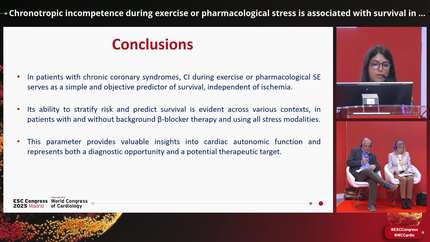
In patients with chronic coronary syndromes, CI during physical or pharmacological stress is a simple, inexpensive, quantitative, and objective predictor of survival.
Contributors


A Zagatina
Author
E Kalinina
Author


J Celutkiene
Author


A Boshchenko
Author
Tomsk National Research Medical Center of the Russian Academy of Sciences Tomsk , Russian Federation


E Picano
Author
Clinical center of Serbia and School of medicine University of Belgrade Belgrade , Serbia
You may be interested in