Impaired right ventricular longitudinal strain in patients diagnosed with cancer
European Heart Journal Supplements


Abstract
Right ventricular (RV) assessment must be a part of the baseline cardiovascular (CV) assessment of patients diagnosed with cancer according to 2022 ESC guidelines on cardio-oncology. This facilitates the calculation of cardiotoxicity risk and enables cardiologists to serially assess RV during and after anticancer treatment.
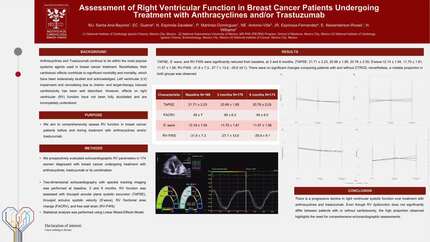
We aimed to assess longitudinal strain of the RV in patients diagnosed with solid and hematological cancers before initiation of any anticancer therapy and compare them with patients without cancer.
This prospective study included 261 patients diagnosed with cancer and 130 patients without cancer (control group). All patients during their baseline CV assessment, had a standard echocardiogram, an electrocardiogram and blood tests as per standard clinical care. Left and right ventricular structure and systolic function, as well as global longitudinal strain of the left ventricle (LVGLS) and of the RV (RVGLS) and global longitudinal strain of the free wall of the RV (RVFWLS) were assessed in all patients.
Baseline characteristics of the study population are presented in Table 1. The cancer cohort included predominantly female patients, with older age, smaller body surface area (BSA), and higher rates of hypertension and diabetes compared to the control group. In the total study population, the assessment of LVGLS was not possible in 8 patients, while of RVGLS and RVFWLS in 18 patients due to suboptimal echocardiographic images. The majority of patients had breast cancer (76,9%), followed by colon cancer. Patients with and without cancer had no significant difference in the systolic function assessed by the conventional echocardiographic parameters (LVEF, TAPSE, RV S’) and in the LVGLS (Table 2). However, cancer patients had significantly impaired longitudinal strain of the RV compared to the control group (RVGLS -18.57% ± 5.36% vs -20.94% ± 3.67%, p < 0.001 and RVFWLS -21.3% ± 5.93% vs -23.42% ± 5.97%, p < 0.001), independently of the assessed CV risk factors. From the blood tests, platelets-to-lymphocytes ratio, that is a prognostic marker of survival in cancer patients, is correlated with RVGLS (rho = -0.152, p=0.04).
Right ventricular strain is impaired in patients diagnosed with cancer, even before any cancer treatment and independently of CV risk factors. The findings of our study highlight the need to assess meticulously the RV at the baseline CV evaluation as suggested by the 2022 ESC cardio-oncology guidelines. Impaired RV longitudinal strain being associated with platelets-to- lymphocytes ratio may be indicative of prognosis too, but prospective studies are need to assess this hypothesis.
Contributors



You may be interested in