Cardioprotection exerted by intravenous statin at index myocardial infarction event attenuates cardiac damage upon recurrent infarction
Cardiovascular Research


Abstract
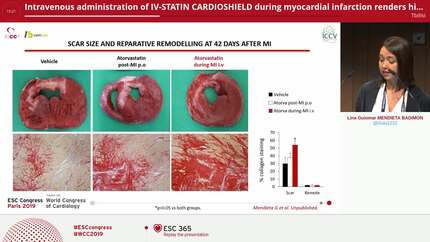
Recurrent acute myocardial infarction (RE-AMI) is a frequent complication after STEMI, and its association with stent thrombosis can be life-threatening. Intravenous atorvastatin (IV-atorva) administration during AMI has been shown to limit infarct size and adverse cardiac remodelling. We determined by cardiac magnetic resonance (CMR) whether the cardioprotection exerted by IV-atorva at the index AMI event translates into a better prognosis upon RE-AMI in dyslipidemic pigs.
Hypercholesterolemic pigs underwent a first AMI (90-min coronary balloon occlusion). During ongoing ischaemia, animals received IV-atorva or vehicle. Forty days later, animals underwent RE-AMI and were sacrificed on Day 43. All animals remained on p.o. atorvastatin and a high-cholesterol diet from the first AMI until sacrifice. Serial CMR analysis was performed on Day 3 post-AMI, prior- (Day 40) and post-RE-AMI (Day 43). No differences were detected in oedema formation in both animal groups during AMI and RE-AMI. Gadolinium DE-CMR revealed smaller infarcts in IV-atorva-treated animals at index event at 3 and 40 days post-AMI compared to vehicle-administered pigs (
The cardioprotection afforded by IV-atorva administration during an index-AMI event shows a legacy effect attenuating myocardial damage and preserving cardiac contractile function upon RE-AMI. The potential benefits of this intravenous approach should be tested in the clinical setting.
Contributors


Soumaya Ben-Aicha
Author
Manuel Gutiérrez
Author
Monika Radike
Author

Lisaidy Ramos
Author
Sebastia Alcover
Author
Laura Casani
Author
Gemma Arderiu
Author

María Borrell-Pages
Author
Lina Badimon
Author
You may be interested in