Automated TTE view selection is accurate and reduces analysis time - results from the PAVE project
European Heart Journal - Cardiovascular Imaging


Abstract
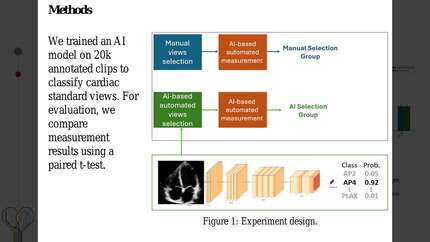
We recently showed, that automated reading of echocardiography images leads to higher accuracy and reproducibility of the respective measurements. A prerequisite for un-supervised automated reading is correct identification of the respective views. An experimental software (eS) was developed that fully automated analyzes DICOM clips according to their content, calculates the probability of containing a certain view, like for example apical 2 chamber or 4 chamber view, and automatically transfers and loads the most suitable DICOM clips (ranked by highest probability of containing a 4 chamber view) in a software for automated strain analysis and quantitative visualization of left atrial function.
To assess accuracy in view selection, potential associated time savings and agreement of automated measurements with manual CoreLab reading. As proof-of-concept, this abstract addresses exclusively the left atrial strain measurement in the apical 4 chamber view.
PAVE (Pathology-oriented automated of echocardiography) is a cooperation project between University Hospital Wuerzburg (UKW) and TOMTEC Imaging Systems GmbH using an established federated machine-learning environment. We randomly selected n=260 routine transthoracic echocardiography (TTE) studies from patients with mild left ventricular hypertrophy and applied eS. An echocardiography expert from the Academic CoreLab Ultrasound-based Cardiovascular Imaging at the Comprehensive Heart Failure Center Würzburg assessed the correctness of the view selection (4 chamber view yes or no). Further, n=100 of these TTE were analyzed by eS as well as by the (blinded) echocardiography expert using the AutostrainLA in the Ultrasound Workspace®. Agreement of measurements was assessed using Bland-Altman analysis.
From the n=260 TTE, n=15 had no suitable 4 chamber view and were excluded from further analyses. In the remaining 245 TTE, the echocardiography expert accepted the eS proposed echo loop as the most suitable for LA analysis in n=222 studies (91 %). In another 14 (6%) and 8 (3%) studies, the first proposed loop was not accepted, but the second or third proposed loop could be analyzed, respectively. Agreement between expert measurements on clips that were manually and automatically selected for LA reservoir strain was -1.1% +-11.84% (Fig. 1). Also the number of clips to be reviewed to perform the measurement decreased within 260 studies from 9875 to 872. The use of eS resulted in time gain of about 28 minutes in the consecutive processing of 50 studies.
Application of eS to clinical routine TTE was feasible. Accuracy in view selection was high and automated reading showed good agreement with manual expert reading. We derived evidence for further improvement of eS aiming for higher accuracy in view selection. Nevertheless, our results support further efforts towards automated reading of echocardiography with minimal user-interaction.
Contributors


N Hitschrich
Author
M Degel
Author
G Schummers
Author
M Le Maire
Author
L Krieger
Author
G Fette
Author
O Karch
Author


You may be interested in