Disparities in clinical characteristics, treatment, and prognosis among immigrants and native patients in Denmark with new-onset heart failure and reduced ejection fraction
European Heart Journal


Abstract
Major variations exist in the causes, age at diagnosis, and outcomes of heart failure (HF) in patients from different parts of the world.
To elucidate this issue further, we compared the characteristics and outcomes of immigrants living in Denmark and native Danish patients presenting with new-onset HF with reduced ejection fraction (HFrEF).
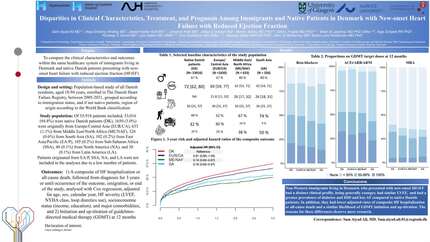
By linkage of the Danish Heart Failure Registry, and nationwide administrative registries, we identified patients with new onset HFrEF, from 2005-2021, grouped according to immigration status and, if not native Danish, region of origin, according to the World Bank classification. Outcomes were a 1) composite of HF hospitalization or all-cause death at 3 years follow-up, and 2) initiation and up-titration of guidelines-directed medical therapy (GDMT) at 12 months follow-up. Cox regression analyses adjusted for age, sex, calendar year, HF severity, socioeconomic status, and major comorbidities were used to compare the primary composite outcome.
Of 33,297 patients included, 31,602 (97.9%) were native Danish patients (DK), 1031 (3.1%) were originally from Europe/Central Asia (EUR/CA), 439 (1.3%) from Middle East/North Africa (ME/NAF), 225 (0.7%) from South Asia (SA). The median time since immigration ranged from 20 to 30 years. Compared to DK, patients originating from ME/NAF, and SA were around 10 years younger (median age 62-64 vs. 71 years), had similar median left ventricular ejection fraction (30% vs. 30%), had lower New York Heart Association (NYHA) ≥ class III (14-16% vs. 23%), had more diabetes (39-51% vs. 20%) and ischemic heart disease (IHD) (69-75 vs. 48%), and had less atrial fibrillation (AF) (9-14% vs. 32%) (all p < 0.0001), patients from EUR/CA were generally similar to DK. The crude 3-year cumulative risk of the primary composite outcome was 34% (DK), 31% (EUR/CA), 27% (SA), and 23% (ME/NAF) (Figure 1) In adjusted analyses with DK as the reference, only ME/NAF was associated with a lower risk; hazard ratio (HR) 0.77 (95% confidence interval (CI) 0.62-0.94) (Figure 2). No major differences in the initiation and up-titration of GDMT were observed across groups.
Non-Western immigrants living in Denmark who presented with new-onset HFrEF had a distinct clinical profile, being generally younger, had lower NYHA class but similar LVEF, a greater prevalence of diabetes and IHD and less AF compared to native Danish patients. In addition, they had lower adjusted rates of the primary outcome of HF hospitalization or all-cause death and a similar likelihood of GDMT initiation and up-titration. The reasons for these differences deserve more research. Crude cumulative risk Adjusted rates
Contributors



J K Kroll
Author


E L F Fosbol
Author

I S Schjodt
Author

P S J Jhund
Author
University of Glasgow Glasgow , United Kingdom of Great Britain & Northern Ireland
L K Kober
Author
F G Gustafsson
Author

N S Sattar
Author
University of Glasgow Glasgow , United Kingdom of Great Britain & Northern Ireland

J M Mcmurray
Author
University of Glasgow Glasgow , United Kingdom of Great Britain & Northern Ireland
You may be interested in