Strauss criteria for left bundle branch block in cardiac resynchronization therapy: improved response with lower ventricular arrhythmic burden
EP Europace Journal


Abstract
The study sought to evaluate the impact of the stricter Strauss criteria for left bundle branch block (St-LBBB) on cardiac resynchronization therapy (CRT) response, hospitalizations, ventricular arrhythmia (VA) events and mortality.
Although left bundle branch block (LBBB) is a strong predictor of response to CRT, a significant number of patients remain non-responders.
This is a retrospective analysis of prospectively collected data on heart failure (HF) patients with LBBB admitted for CRT implantation. Patients were divided in two groups according to the fulfillment or not of St-LBBB criteria.
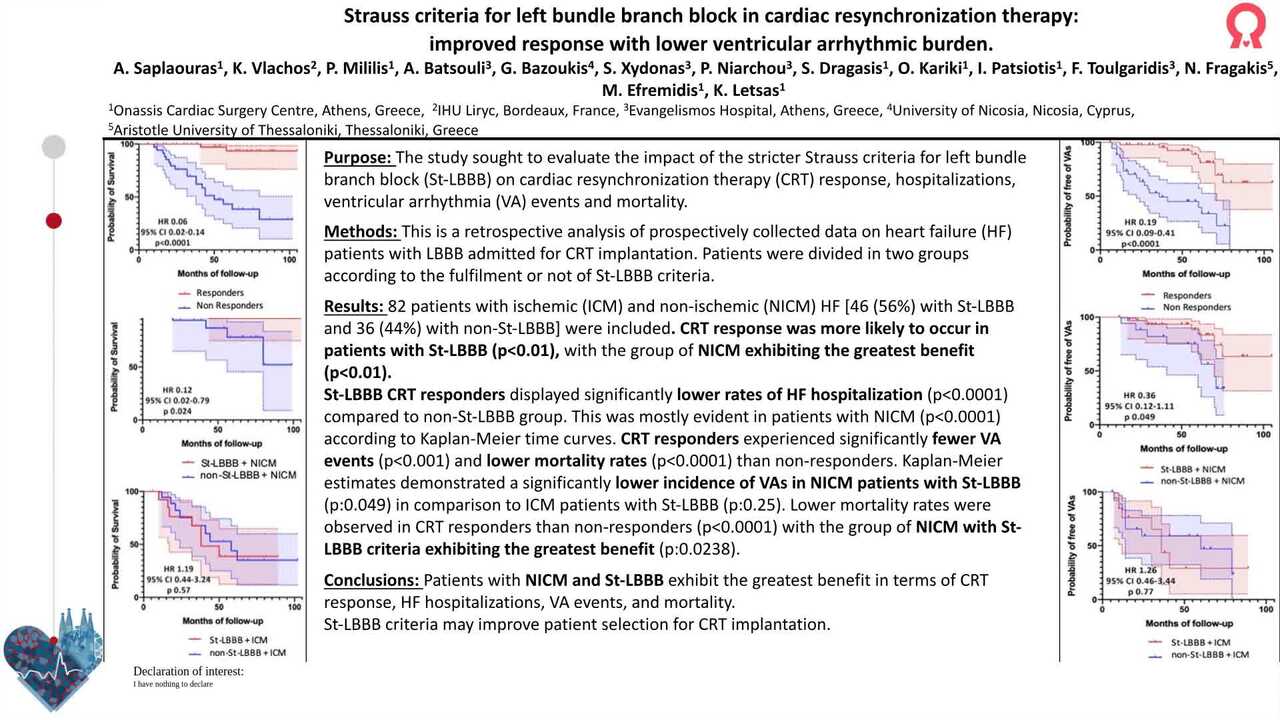
82 patients with ischemic (ICM) and non-ischemic (NICM) HF [46 (56%) with St-LBBB and 36 (44%) with non-St-LBBB] were included. CRT response was more likely to occur in patients with St-LBBB (p<0.01), with the group of NICM exhibiting the greatest benefit (p<0.01). St-LBBB CRT responders displayed significantly lower rates of HF hospitalization (p<0.0001) compared to non-St-LBBB group. This was mostly evident in patients with NICM (p<0.0001) according to Kaplan-Meier time curves. CRT responders displayed significantly fewer VA events (p<0.001) and lower mortality rates (p<0.0001) than non-responders. Kaplan-Meier estimates demonstrated a significantly lower incidence of VAs in NICM patients with St-LBBB (p:0.049) in comparison to ICM patients with St-LBBB (p:0.25). Lower mortality rates were observed in CRT responders than non-responders (p<0.0001) with the group of NICM with St-LBBB criteria exhibiting the greatest benefit (p:0.0238).
Patients with NICM and St-LBBB present the greatest benefit with respect to CRT response, HF hospitalizations, VA events, and mortality. St-LBBB criteria may improve patient selection for CRT.
Contributors



You may be interested in