Anticoagulation with edoxaban in patients with long atrial high-rate episodes ≥24 h
European Heart Journal


Abstract
Patients with long atrial high-rate episodes (AHREs) ≥24 h and stroke risk factors are often treated with anticoagulation for stroke prevention. Anticoagulation has never been compared with no anticoagulation in these patients.
This secondary pre-specified analysis of the Non-vitamin K antagonist Oral anticoagulants in patients with Atrial High-rate episodes (NOAH-AFNET 6) trial examined interactions between AHRE duration at baseline and anticoagulation with edoxaban compared with placebo in patients with AHRE and stroke risk factors. The primary efficacy outcome was a composite of stroke, systemic embolism, or cardiovascular death. The safety outcome was a composite of major bleeding and death. Key secondary outcomes were components of these outcomes and electrocardiogram (ECG)-diagnosed atrial fibrillation.
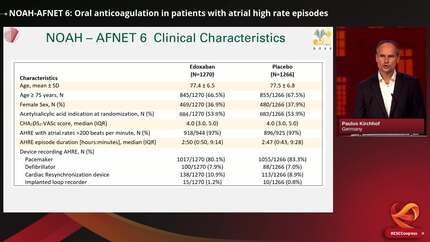
Median follow-up of 2389 patients with core lab-verified AHRE was 1.8 years. AHRE ≥24 h were present at baseline in 259/2389 patients (11%, 78 ± 7 years old, 28% women, CHA2DS2-VASc 4). Clinical characteristics were not different from patients with shorter AHRE. The primary outcome occurred in 9/132 patients with AHRE ≥24 h (4.3%/patient-year, 2 strokes) treated with anticoagulation and in 14/127 patients treated with placebo (6.9%/patient-year, 2 strokes). Atrial high-rate episode duration did not interact with the efficacy (
This hypothesis-generating analysis does not find an interaction between AHRE duration and anticoagulation therapy in patients with device-detected AHRE and stroke risk factors. Further research is needed to identify patients with long AHRE at high stroke risk.
Contributors


Tobias Toennis
Author


Nuno Cabanelas
Author
Melanie Calvert
Author
A John Camm
Author
Gregory Chlouverakis
Author
Gheorghe-Andrei Dan
Author

Hans Christoph Diener
Author
Institute for Medical Informatics, Biometry and Epidemiology Essen , Germany
Alexander Fierenz
Author
Andreas Goette
Author


Astrid N L Hermans
Author
Maastricht University Medical Centre (MUMC) Maastricht , Netherlands (The)
Gregory Y H Lip
Author
Andrzej Lubinski
Author

Béla Merkely
Author

Ann-Kathrin Ozga
Author
Kim Rajappan
Author
Andrea Sarkozy
Author


Ulrich Schotten
Author
Susanne Sehner
Author
Emmanuel Simantirakis
Author
Panos Vardas
Author
Vasil Velchev
Author
Dan Wichterle
Author
Antonia Zapf
Author

You may be interested in