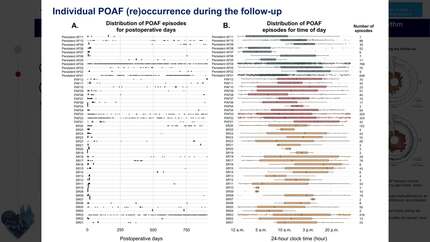
Time of onset of atrial fibrillation and atrial fibrillation progression data from the RACE V study
EP Europace Journal


Abstract
Atrial fibrillation (AF) progression is associated with adverse outcome, but the role of the circadian or diurnal pattern of AF onset remains unclear. We aim to assess the association between the time of onset of AF episodes with the clinical phenotype and AF progression in patients with self-terminating AF.
The Reappraisal of AF: Interaction Between Hypercoagulability, Electrical Remodelling, and Vascular Destabilization in the Progression of AF study included patients with self-terminating AF who underwent extensive phenotyping at baseline and continuous rhythm monitoring with an implantable loop recorder (ILR). In this subanalysis, ILR data were used to assess the development of AF progression and the diurnal pattern of AF onset: predominant (>80%) nocturnal AF, predominant daytime AF, or mixed AF without a predominant diurnal AF pattern. The median follow-up was 2.2 (1.6–2.8) years. The median age was 66 (59–71) years, and 117 (42%) were women. Predominant nocturnal (
In self-terminating AF, patients with either predominant nocturnal or daytime onset of AF episodes had less associated comorbidities and less AF progression compared to that of patients with mixed onset of AF.
NCT02726698
Contributors

Martijn E van de Lande
Author


Vicente Artola Arita
Author
Bao-Oanh Nguyen
Author

Vanessa Weberndorfer
Author

Harry J G M Crijns
Author
Cardiovascular Research Institute Maastricht (CARIM) Maastricht , Netherlands (The)

Robert G Tieleman
Author

Ulrich Schotten
Author
Dominik Linz
Author
Isabelle C Van Gelder
Author

You may be interested in