Beta-blockers after acute coronary syndrome: insights across the ejection fraction spectrum
EHJ - Open


Abstract
To evaluate the association between beta-blocker (BB) prescription and long-term all-cause mortality after acute coronary syndrome (ACS), and to assess whether this varies across the left ventricular ejection fraction (LVEF) spectrum.
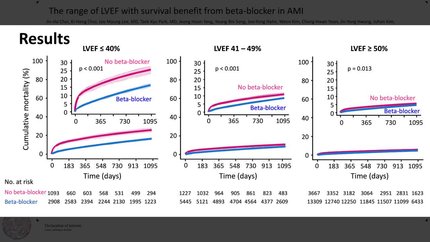
We analysed ACS patients from the retrospective multicentre CardioMining study (NCT05176769). The primary analysis used inverse probability of treatment weighting (IPTW) and restricted mean survival time (RMST) derived from weighted Kaplan–Meier curves. RMST and survival differences were estimated at 1 and 5 years. A landmark analysis evaluated survival between years 1 and 5 among first-year survivors. Among 6049 ACS patients (age 66.8 ± 13.2 years; 74.9% male), 5107 (84.4%) were discharged on BBs. During a median 4.6-year follow-up, 1912 deaths (31.6%) occurred. Overall, the 1-year RMST difference associated with BBs was 6.3 days (95%CI 0.0 to 13.2), which attenuated further by 5 years (11.3 days, 95%CI −30.7 to 63.9). The largest 1-year RMST difference was observed among patients with LVEF ≤40% (18.8 days, 95%CI 1.1 to 37.4), whereas associations were smaller and non-significant among patients with LVEF 41–49% and LVEF ≥50%. At 5 years, confidence intervals crossed the null across all LVEF categories. Continuous LVEF analyses suggested greater short-term benefit at lower values, with progressive attenuation across the LVEF spectrum. Among 1-year survivors, no significant RMST differences were observed between years 1 and 5.
Discharge BB prescription was not associated with a clear long-term survival advantage after ACS in this large real-world cohort. Apparent associations were strongest at lower LVEF values and attenuated during longer follow-up.
Contributors

Eirinaios Tsiartas
Author
Cambridge University Hospital NHS Trust Cambridge , United Kingdom of Great Britain & Northern Ireland

Sokratis Oikonomou
Author
Aristea Iordanidou
Author
Athanasios Samaras
Author


Antonios Ziakas
Author
Periklis Davlouros
Author
Konstantinos Tsioufis
Author
Dimitrios N Tziakas
Author
Ioannis Zarifis
Author

You may be interested in