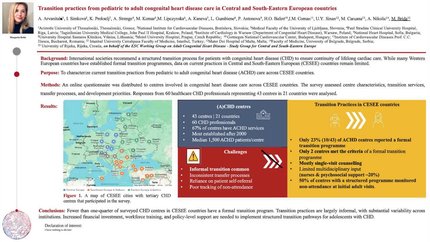
Transition from paediatric to adult congenital heart disease care in Central and South-Eastern Europe: current practices and opportunities for improvement
EHJ - Open


Abstract
Transition from paediatric to adult congenital heart disease (ACHD) care is a critical determinant of lifelong disease management for individuals with congenital heart disease (CHD). However, structured transition programmes remain inconsistently implemented, and data are lacking on current practices in Central and South-Eastern European (CESEE) countries. This study aimed to evaluate existing transition practices across CESEE and to identify opportunities to improve the development and implementation of structured programmes.
An online questionnaire was distributed to centres involved in CHD care across CESEE countries. The survey assessed centre characteristics, transition services, transfer processes, and development priorities. Responses from 60 healthcare CHD professionals representing 43 centres in 21 countries were analysed. A formal ACHD service was reported in 29 (67%) of 43 centres, mostly established after the year 2000 (72%), caring for a median of 1500 (interquartile range 782–4000) patients with ACHD. Overall, only 10 (23%) centres reported having a formal transition programme. Transition counselling was typically delivered in a single outpatient visit, commonly involving paediatric and adult CHD physicians, but rarely nurses and psychosocial professionals (20% each). Structured transfer processes were inconsistently implemented, and only half of the centres monitored non-attendance at initial adult visits. In centres without formal programmes, informal counselling largely occurred at the final paediatric or first adult visit, relying on patient self-referral, and lacking follow-up.
Formal transition programmes remain limited across CESEE ACHD centres. Standardized clear pathways, investment in dedicated transition clinics, and trained workforce are needed to improve continuity of care for adolescents with CHD.
Contributors



Irena Ivanac Vranešić
Author
Agnese Strenge
Author
Monika Komar
Author
Magdalena Lipczynska
Author
Anna Kaneva
Author

Petra Antonova
Author
Hajnalka Olga Balint
Author
Ioan Mircea Coman
Author


Maarja Maser
Author
Elena Panfile
Author
Margarita Bartsota
Author


Tamara Kovačević-Preradović
Author
University Clinical Centre of the Republic of Srpska Banja Luka , Bosnia and Herzegovina

Pencho Kratunkov
Author
Lidia Tomkiewicz-Pajak
Author
Yuliia Klymyshyn
Author
Ihor Lebid
Author
Michael A Gatzoulis
Author

Magnus Bäck
Author
You may be interested in