Histological evaluation of clinically defined atrial cardiomyopathy stages and their association with atrial fibrillation burden under continuous monitoring for a 2.5-year follow-up

EP Europace Journal

21 July 2026
Organised by: Logo
ESC Journals BASIC SCIENCE

Abstract

AbstractBackground and Aims

Atrial cardiomyopathy (AtCM) is associated with atrial fibrillation (AF). While histological studies describe underlying mechanisms of AtCM, these insights remain disconnected from clinical AtCM. This study determines the histological basis of non-invasive AtCM markers and assess their prognostic value in patients undergoing cardiac surgery.

Methods and results

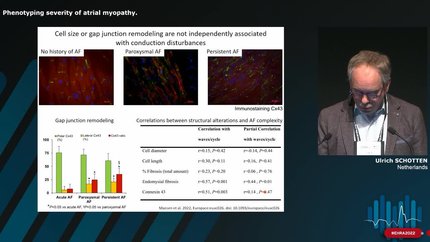
Left and right (LA/RA) atrial tissue samples were obtained in patients undergoing cardiac surgery (n = 136) in the RACE V Tissue Bank study. Pre-operative rhythm history, digital ECG, transthoracic echocardiography (TTE) and biomarker levels were used to group patients in AtCM stages: AF: history of paroxysmal, persistent or permanent AF, Severe (LAVi>50 mL/m2 or LAEF<35%), Moderate (LAVi 34–50 mL/m2, or LAEF 35–50% AND NT-proBNP >250 pg/mL), Mild (no AF, LAVi≤34 mL/m2 AND P-terminal Force V1 > 5 mV*ms OR P wave duration > 120 ms), and no AtCM. Tissue was stained (WGA/CD31/Vimentin) to quantify fibrosis, fibroblast density, myocyte diameter and vascularization. Post-operative rhythm was monitored continuously (2.5 years) using implantable loop recorders. Patients with severe AtCM had extended endomysial fibrosis (LA: +0.82µm, pFDR,LA < 0.001; RA: +0.64µm, pFDR,RA = 0.010) and larger left atrial cardiomyocytes (LA: +0.92µm, pFDR,LA = 0.026). Moderate AtCM patients showed LA myocyte hypertrophy (LA: +1.35µm, pFDR,LA = 0.007). Mild AtCM patients had similar histological features to patients without AtCM. Moderate (β = 3.56, pFDR = 0.045) and severe (β = 3.74, pFDR = 0.034) AtCM patients had a higher AF burden late after cardiac surgery.

Conclusion

Clinical AtCM markers reflect pro-fibrotic and pro-hypertrophic remodelling in the moderate to severe AtCM stages and are associated with a higher AF burden late after surgery.

Contributors

Michiel Rienstra
Michiel Rienstra

Author

University Medical Centre Groningen Groningen , Netherlands (The)

Isabelle van Gelder
Isabelle van Gelder

Author

University Medical Centre Groningen Groningen , Netherlands (The)

Ulrich Schotten
Ulrich Schotten

Author

Cardiovascular Research Institute Maastricht (CARIM) Maastricht , Netherlands (The)