Catheter ablation of atrial fibrillation in transthyretin and light-chain cardiac amyloidosis: results from the multicentre AMYL-AF study
EP Europace Journal


Abstract
Atrial fibrillation (AF) is highly prevalent among cardiac amyloidosis (CA) patients and contributes significantly to their morbidity and mortality. Evidence regarding AF ablation efficacy and safety in CA patients remains limited. The aim of our study is to evaluate baseline characteristics, clinical course and outcomes of AF ablation in a series of patients with transthyretin (ATTR) or light-chain (AL) CA from a multicentre international registry.
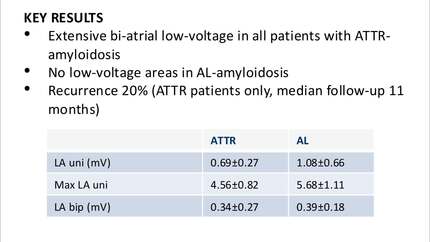
Patients with CA who underwent AF ablation were included. Co-primary endpoints were: (i) atrial arrhythmia (AA) recurrence; (ii) a composite endpoint of all-cause mortality and heart failure hospitalization (HFH). 109 patients (mean age 72.4 ± 7.4 years, females 17.4%, persistent AF 64.2%, ATTR 78%, AL 22%) were included. Radiofrequency, cryo-balloon and pulsed-field ablation were performed in 67%, 15% and 18% of patients, respectively; 49.5% received pulmonary vein isolation plus additional ablations. Low voltage zones were documented in 34 out of 44 patients undergoing electro-anatomical mapping (77.3%). During a median follow-up of 22.7 months, 63 patients (58.3%) experienced AA recurrence (32.4% persistent AF recurrence), with no significant differences between CA subtypes (ATTR 59.5% vs. AL 54.2%, log-rank
CA patients undergoing AF ablation present high prevalence of persistent AF. Freedom from AA after AF ablation is achieved in 42% of patients after a two-year follow-up. Patients with persistent AF recurrence have a three-fold higher risk of HFH and death.
Contributors



Michel Haïssaguerre
Author

Carlo De Asmundis
Author
Giuseppe Ciconte
Author
Marta De Riva
Author


Mikael Laredo
Author


Andrea Rossi
Author

Lia Crotti
Author


Moises Levinstein
Author
Sebastiaan R D Piers
Author
Maria L Caputo
Author
Carlo Pappone
Author
Domenico G Della Rocca
Author
Paolo Compagnucci
Author
Raffaele Salerno
Author
Chiara Pavone
Author
Valeria Rella
Author
Katharina I Gölly
Author
Lorenzo Gigli
Author
Cristina Chimenti
Author
Nicolas Johner
Author
Alessandro Laschera
Author
Manuela Averaimo
Author
Esther Scheirlynck
Author


You may be interested in