Increased risk of new-onset ischaemic stroke and TIA in women after catheter ablation for typical atrial flutter: a nationwide cohort study
EP Europace Journal


Abstract
Catheter ablation is an effective treatment for cavotricuspid isthmus (CTI)-dependent typical atrial flutter (AFL). Ischaemic stroke and transient ischaemic attack (IS/TIA) are among the most feared adverse events following atrial fibrillation (AF) ablation. However, real-world data on the incidence and predisposing factors of IS/TIA after ablation for typical AFL remain limited.
We investigated the incidence and predisposing factors for new-onset IS/TIA after first-time catheter ablation procedures for typical AFL performed in Finland between 2012 and 2016.
Finnish AntiCoagulation in Atrial Fibrillation (FinACAF) is a registry-linkage study including all patients with AF and AFL in Finland between 2007-2018. Catheter ablations for typical AFL were identified via procedural codes. Associations between clinical characteristics and new-onset IS/TIA during two-year follow-up were assessed.
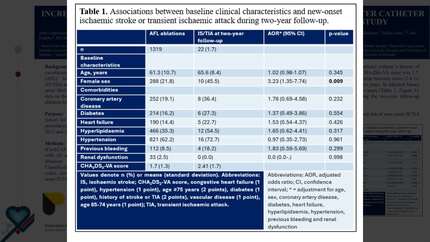
A total of 1319 first-time catheter ablations for typical AFL were identified in patients without a prior history of IS/TIA. Of these, 21.8% were women, and the mean CHA2DS2-VA score was 1.7. The mean age was 61.3 years, with women being older than men (63.0 vs. 60.9 years, p = 0.003). CHA2DS2-VA scores were similar between sexes (1.8 vs. 1.7, p = 0.425). The incidence of new-onset IS/TIA was 0.2% at one month and 1.7% at two years. In adjusted binary logistic regression analysis, female sex was the only significant predictor of IS/TIA at two years (Table 1, Figure 1). Additionally, in unadjusted analysis, the CHA2DS2-VA score also predicted IS/TIA during the two-year follow-up (OR 1.45, 95% CI 1.08-1.94, p=0.012).
In this unselected nationwide cohort, female sex was associated with an increased risk of new-onset IS/TIA during the two-year follow-up after catheter ablation for typical AFL.



You may be interested in