Targeting sirt6 with mdl-800 attenuates cardiac fibroblast fibrosis and promotes autophagy
Cardiovascular Research


Abstract
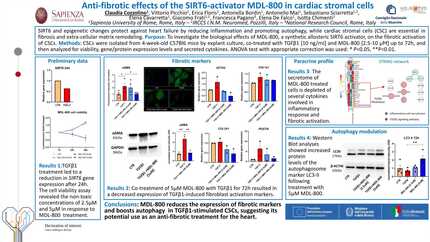
Epigenetic changes contribute to stress responses and tissue remodeling in heart failure. Sirtuins exert anti-fibrotic effects by modulating inflammation and autophagy. Sirtuin6 (SIRT6) protects cardiomyocytes by limiting senescence and hypertrophy, but its role in cardiac fibroblasts (CFs) is still unclear.
To investigate the effects of the allosteric SIRT6 activator MDL-800 on CF stress response and fibrotic activation.
CFs were isolated from 4-week-old C57BL/6J mice and stimulated with 10 ng/ml TGF-beta1 (TGFb1) for up to 72h. Cells were treated with MDL-800 (up to 10 µM) in the presence of TGFb1 and analysed for viability and gene/protein expression.
TGFb1 stimulation led to a 0.69-fold reduction in SIRT6 gene expression after 24h (p<0.01; N=3). Viability dose-response to MDL-800 was assessed via MTS assay up to 72h; non-toxic concentrations of 2.5 µM and 5 µM were selected for further experiments (2.5µM vs CTR 0.97-fold and 5µM vs CTR 0.92-fold, normalized OD vs t0). Treatment with 5 µM MDL-800 + TGFb1 increased SIRT6 gene expression (TGFb1 vs CTR: 0.95-fold; 5 µM vs TGFb1: 1.68-fold; N=2) and significantly upregulated SIRT6 protein levels (TGFb1 vs CTR: 1.25-fold; 5 µM vs TGFb1: 2.47-fold; p<0.01; N=4), consequently reducing H3K9 acetylation, the primary deacetylase target of SIRT6 (5 µM vs TGFb1: 0.64-fold; N=2). Phenotypically, co-treatment with 5 µM MDL-800 and TGFb1 for 72h resulted in a dose-dependent decrease in fibroblast activation markers. This was confirmed by immunofluorescence staining for aSMA (TGFb1 vs CTR 2.21-fold, p<0.05; 5µM vs TGFb1 0.46-fold, p<0.05, N=4; mean fluorescence intensity). The anti-fibrotic effect was further validated by Real-Time PCR, which showed a reduction in the mRNA expression of multiple fibrotic markers, including Acta2 (TGFb1 vs CTR 1.67-fold, 5µM vs TGFb1 0.29-fold; N=2), COL1a1 (TGFb1 vs CTR 1.32-fold, 5µM vs TGFb1 0.87-fold; N=2) COL3a1 (TGFb1 vs CTR 1.06-fold, 5µM vs TGFb1 0.43-fold; N=2) and POSTN (TGFb1 vs CTR 6.37-fold, 5µM vs TGFb1 0.23-fold; N=2). Consistently, secretome profiling revealed that MDL-800–treated cells display a marked depletion of several cytokines involved in inflammatory signaling and fibrotic activation, indicating an additional paracrine component to its anti-fibrotic action (WP2292; WP113). Furthermore, Western Blot analyses revealed increased protein levels of the autophagosome marker LC3-II following treatment with 5 µM MDL-800 (TGFb1 vs CTR 0.95-fold; 5µM vs TGFb1 3.01-fold), suggesting autophagy enhancement as a potential mechanism underlying the observed anti-fibrotic effects.
MDL-800 treatment in CFs is associated with a dose-dependent reduction of TGFb1-induced fibrotic markers and to increased levels of the autophagy marker, suggesting its potential use as an anti-fibrotic molecule for the heart.
Contributors



You may be interested in