Tricuspid valve replacement outcomes by baseline tricuspid regurgitation severity: the TRISCEND II trial
European Heart Journal


Abstract
The TRISCEND II trial demonstrated superior clinical benefits for patients with ≥severe tricuspid regurgitation (TR) treated with the EVOQUE transcatheter tricuspid valve replacement (TTVR) system plus medical therapy vs medical therapy alone. This work reports 1-year and 18-month outcomes in patients stratified by baseline TR severity.
The multicentre, prospective TRISCEND II trial enrolled 400 patients with symptomatic, ≥severe TR, and randomized 2:1 to TTVR (
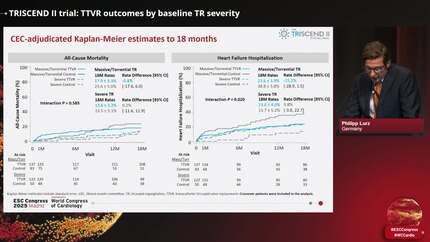
One year after TTVR, TR was ≤mild in 95.2% of severe TR and 95.3% of massive/torrential TR patients. The primary safety and effectiveness endpoint (win ratio) favoured TTVR over control regardless of baseline TR severity: severe {1.64 [95% confidence interval (CI): 1.11, 2.43]} and massive/torrential [2.20 (1.55, 3.14)]. At 18 months, TTVR patients had similar mortality to controls [rate difference: severe 0.2% (−11.6, 11.9), massive/torrential −5.8% (−17.6, 6.0)], whereas HF hospitalization rates favoured TTVR in the massive/torrential cohort [vs control, severe 9.8% (−3.0, 22.7), massive/torrential -15.2% (−28.9, −1.5)].
Patients with ≥severe TR benefit from TTVR, experiencing improvements in TR severity, functional capacity, and quality of life regardless of baseline TR severity, with a signal for greater benefit in patients with more advanced disease.
Contributors

Philipp Lurz
Author

Susheel Kodali
Author
Raj Makkar
Author
Rahul P Sharma
Author
Charles J Davidson
Author
Brian P O’Neill
Author
Pradeep Yadav
Author
Firas Zahr
Author
Scott Chadderdon
Author
Mackram F Eleid
Author
Molly Szerlip
Author
Robert L Smith
Author
Brian Whisenant
Author
Santiago Garcia
Author
Tobias Kister
Author
Robert M Kipperman
Author
D Scott Lim
Author
John Saxon
Author
Samir Kapadia
Author
James Hermiller
Author
Jacob M Mishell
Author
Andrew Rassi
Author
Howard C Herrmann
Author
Wilson Szeto
Author
Jörg Hausleiter
Author
Vasilis Babaliaros
Author
Colin M Barker
Author
Brian R Lindman
Author
Azeem Latib
Author
Kamran Muhammad
Author

Matthew Summers
Author
Stanley J Chetcuti
Author
Gorav Ailawadi
Author
Mark Russo
Author
Michael Rinaldi
Author
Bassem M Chehab
Author
Georg Nickenig
Author
Curtiss Stinis
Author
Ignacio Inglessis-Azuaje
Author
Abhijeet Dhoble
Author
Adnan K Chhatriwalla
Author
George Petrossian
Author
Pinak Shah
Author
Cezar Staniloae
Author
Mathew Williams
Author
Marcos Nores
Author
James M McCabe
Author
Gagan Singh
Author
Stephan Baldus
Author

Ilie Barb
Author
Charles Klodell
Author
William Gray
Author
Justin Strote
Author

Paul Grayburn
Author
Michael J Mack
Author
Martin B Leon
Author
Vinod H Thourani
Author
You may be interested in