RNA-targeted therapeutics in arterial hypertension
European Heart Journal - Quality of Care and Clinical Outcomes


Abstract
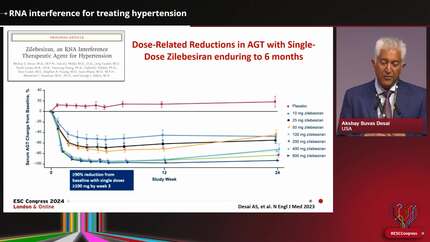
Hypertension is a common and serious medical condition affecting millions of people worldwide. While existing treatments are effective for many hypertensive patients, up to one-third fail to achieve adequate blood pressure control—often due to poor adherence, complex polypharmacy, or true pharmacological resistance. In this context, novel precision medicine approaches such as RNA-targeted therapeutics may represent tailored, long-acting alternatives particularly beneficial for patients with resistant hypertension, poor compliance, or multiple comorbidities. Small interfering RNAs (siRNAs) and antisense oligonucleotides (ASOs) have shown promising results as potential treatments for hypertension. On the one hand, zilebesiran (formerly ALN-AGT01) is currently in phase 2 clinical trials and targets the hepatic synthesis of angiotensinogen through a novel mechanism of action. On the other hand, IONIS-AGT-LRX is a hepatocyte-directed antisense oligonucleotide designed to target AGT mRNA in hepatocytes, thereby reducing angiotensinogen synthesis and circulating plasma levels. Furthermore, literature show sparse trials on RNA-targeted nucleic acid therapeutics as potential hypertension treatment, in preclinical and clinical phases, in animal and human targets, analyzed in this review in their safety and efficacy. RNA-based drugs, administered as subcutaneous injections, offer several advantages over traditional antihypertensive agents, including greater target specificity and prolonged duration of action, potentially improving adherence and long-term blood pressure control. However, these therapies are not suitable for the acute management of hypertensive emergencies or urgencies, and evidence regarding their effects on cardiovascular outcomes, target organ protection, and mortality is still lacking. Further studies are warranted to define their role in clinical practice.
Contributors



Luana Orlando
Author
Francesca Amati
Author
Flavio D’Ascenzi
Author
Riccardo Liga
Author
Anna Vittoria Mattioli
Author
Marianna Gigliotti De Fazio
Author
Maria Concetta Pastore
Author
Andrea Rinaldi
Author

Matteo Cameli
Author
You may be interested in