Clinical presentation, mechanisms and symptom evolution of ischemia with non-obstructive coronary artery disease in Italy: the INOCA-IT Registry
European Heart Journal Supplements


Abstract
Patients with ischemia with non-obstructive coronary artery (INOCA) disease still represent a diagnostic and therapeutic challenge.
The aims of this study were: 1.determine gender and geographical differences in INOCA in Italy (North, Centre and South); 2.stratify patients into different INOCA endotypes; 3.prescribe tailored therapy; 4.evaluate the impact of such tailored therapy on angina severity and quality of life (QOL) at 1-year follow-up.
INOCA-IT Registry (RF-2019-12369486) prospectively enrolled consecutive patients with angina and/or documented inducible myocardial ischemia, without obstructive coronary artery disease (CAD) on coronary angiography at three centers in Italy.
Enrolled patients underwent invasive coronary functional tests assessing Coronary Flow Reserve (CFR) and Index of Microvascular Resistance (IMR), as well as Acetylcholine (ACh) provocative test. The identified endotypes werecoronary microvascular dysfunction (CMD), vasospastic angina (VSA), microvascular spasm (MVS) and chest pain of non-cardiac origin (NCO). Patients received a tailored therapy and the impact on angina severity and on QOL was quantified via the Seattle Angina Questionnaire (SAQ) and EQ-5D-5L questionnaire at 1-year follow-up.
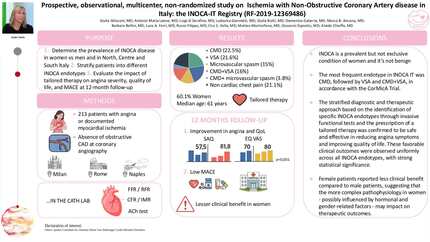
From December 2021 to February 2024, 213 patients were enrolled, the median age was 61 years and 60.1% were female.The prevalence of traditional cardiovascular risk factors was high (Figure 1). Most patients experienced typical chest pain (87.3%) with 89.6% of patients in Canadian Cardiovascular Society (CCS) class ≥ II.
The prevalence of INOCA endotypes is shown in Figure 1 and CMD was the most frequent (22.5%). Women showed a trend towards higher prevalence of MVS, isolated (18.8%vs9.4%, p=0.062) or combined with CMD (6.3%vs0%, p=0.019). The geographic distribution of endotypes was uniform across centers, with a higher percentage of NCO chest pain in the South (32.1%, p=0.05).
At 1-year clinical follow-up, CCS angina class (p for overall comparison<0.001), median SAQ summary score (from 57.5 to 81.8, p<0.001) and New York Heart Association (NYHA) class (p for overall comparison <0.001) improved significantly. In addition, SAQ scores showed substantial gains in each domain, all with statistical significance (p<0.001). Similarly, each EQ-5D-5L domain improved significantly, with an increase of the EuroQol Visual Analogue Scale (EQ VAS) from 70 to 80 (p<0.001) (Figure 2). Women reported worse angina severity and QOL compared to men both at baseline (median SAQ Score 56.4vs61.1, p<0.005; EQ VAS 65vs75, p<0.005) and at follow-up, despite receiving endotype-guided therapy (median SAQ Score 79.9vs82.9, p<0.05)
Our study confirms that INOCA is more prevalent in women and the most frequent endotype in INOCA-IT Registry was CMD. The stratified diagnostic and therapeutic approach was associated to a reduction of angina symptoms and improvement of quality of life.
Contributors


G Ghizzoni
Author

L Di Serafino
Author
D Galante
Author
L Giannetti
Author
L Ciaramella
Author

C Giuliana
Author
G Vitale
Author
C Trani
Author
F Burzotta
Author
G Esposito
Author
A Chieffo
Author
You may be interested in