Clinical complexity in patients with atrial fibrillation: exploring differential risk profiles from European and Asian cohorts
EP Europace Journal


Abstract
Clinical complexity (CC) in atrial fibrillation (AF) reflects overlapping risk factors that raise vulnerability to both thromboembolism and bleeding. Ethnic differences in the expression of CC remain poorly characterized.
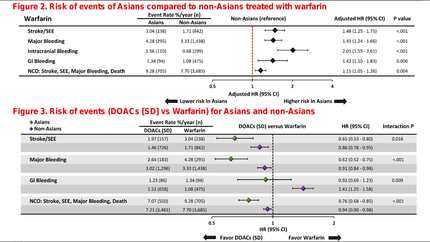
We performed a post hoc analysis of the EORP-AF and APHRS-AF registries. CC was defined as a CHA₂DS₂–VASc score ≥2 plus ≥1 of: (i) age ≥75 and BMI <23 kg/m², (ii) chronic kidney disease, or (iii) prior major bleeding. Multivariable logistic regression identified predictors of CC, oral anticoagulant (OAC) use, and rhythm control. The primary outcome was a composite of all-cause death and major adverse cardiovascular events (MACE), defined as cardiovascular death, acute coronary syndromes, and thromboembolic events. Secondary outcomes included each individual component and major bleeding. Associations were assessed using Cox regression models. Among 14 055 patients, 2794 (19.9%) met CC criteria (mean age 77 ± 9 years; 46% female). Compared to Europeans, Asian patients with CC had a distinct clinical profile and were less likely to receive OAC (OR 0.75, 95% CI 0.57–1.01) or rhythm control (OR 0.53, 95% CI 0.41–0.69). CC was independently associated with increased risk of composite outcome (HR 1.55, 95% CI 1.35–1.77), all-cause death (HR 1.65, 95% CI 1.42–1.93), MACE (HR 1.50, 95% CI 1.26–1.80), cardiovascular death (HR 1.81, 95% CI 1.40–2.36), and major bleeding (HR 2.02, 95% CI 1.47–2.77). The excess risk of the composite outcome was greater in Asians (HR 2.28, 95% CI 1.57–3.32) than in Europeans (HR 1.51, 95% CI 1.31–1.75;
Among AF patients with CC, those enrolled in Asia exhibited marked differences in clinical profiles, management strategies, and outcomes, suggesting greater vulnerability to CC in the Asian population.
Contributors


Michele Rossi
Author


Amir Askarinejad
Author
Institute of Life Course and Medical Sciences Liverpool , United Kingdom of Great Britain & Northern Ireland


Hung-Fat Tse
Author


Gregory Y H Lip
Author
University of Liverpool Liverpool , United Kingdom of Great Britain & Northern Ireland
You may be interested in