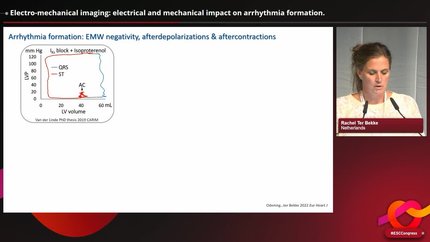
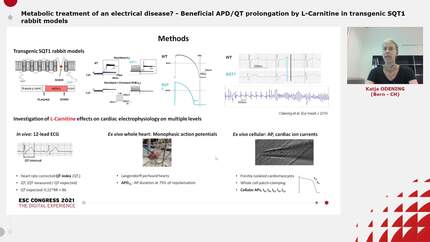
Mechano-electrical feedback in transgenic rabbit models of long QT syndrome Type 2 and short QT syndrome Type 1
EP Europace Journal


Abstract
Electromechanical coupling and mechano-electrical feedback (MEF) are crucial for cardiac function, but their pro-arrhythmic roles in short and long QT syndromes (SQT1 and LQT2) are not fully understood. We aimed to evaluate MEF-induced electrical changes, their arrhythmic impact, and the involvement of stretch-activated channels (SACs) in transgenic rabbit models of SQT1 and LQT2.
Patch-clamp and fluorescence imaging were used to analyse action potential duration (APD), Ca²⁺ transients, and contractility in ventricular cardiomyocytes (VCMs) from LQT2, SQT1 and wild-type (WT) rabbits. LQT2 cells showed prolonged APD and Ca²⁺ transients, increased early afterdepolarizations, Ca²⁺ oscillations, and impaired mechanics compared to WT and SQT1. The cellular electromechanical window (Ca²⁺-transient duration minus APD) was more negative in LQT2 and more positive in SQT1 than in WT. QTc prolonged with preload/afterload increase and decreased with preload reduction across all genotypes, but MEF-induced QTc changes and dispersion were most pronounced in LQT2.
Mechano-electrical feedback-induced electrical changes, partly mediated by SACs, occur in WT, SQT1, and LQT2, but MEF effects are strongest in LQT2. Mechano-electrical feedback induces pro-arrhythmic effects
Contributors

Nicolò Alerni
Author
Melania Buonocunto
Author

Julien Louradour
Author
Miriam Barbieri
Author
Lucilla Giammarino
Author
Lluis Matas
Author

Joost Lumens
Author
Cardiovascular Research Institute Maastricht (CARIM) Maastricht , Netherlands (The)
Tammo Delhaas
Author
Gideon Koren
Author
Ruben Lopez
Author
Manfred Zehender
Author


You may be interested in