Physical activity and risk of adverse events in atrial fibrillation: evidence from European and Asian cohorts

EP Europace Journal

1 March 2026
Organised by: Logo
ESC Journals ARRHYTHMIAS AND DEVICE THERAPY Atrial Fibrillation (AF) PREVENTIVE CARDIOLOGY Risk Factors and Prevention

Abstract

AbstractAims

To evaluate differences in clinical characteristics and outcomes based on physical activity levels in patients with atrial fibrillation (AF), comparing Europeans and Asians.

Methods and results

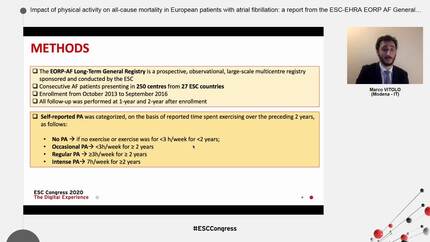
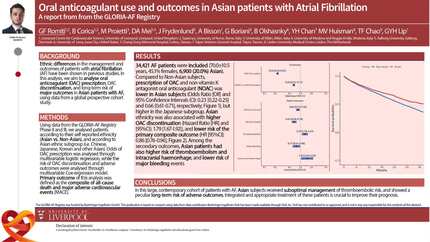
Post-hoc analysis of two prospective registries from Europe and the Asia-Pacific. Patients were classified as inactive (no exercise or <3 h/week) or active (≥3 h/week). The primary outcome was a composite of all-cause death and major adverse cardiovascular events (MACE). Secondary outcomes included all-cause death, MACE, major bleeding, individual MACE components. Cox model estimated hazard ratios (HRs) and 95% confidence intervals (CIs) for outcomes. Subgroup analyses were performed by clinically relevant variables and enrolment setting. Of 13 126 participants (69 ± 12 years; 39% female), 3639 (28%) were physically active and 9487 (72%) physically inactive. Across both groups, Asians had lower odds of obesity, symptomatic AF and heart failure, but higher odds of cardiovascular risk factors than Europeans. After a median follow-up of 514 days, physically active AF patients had a lower risk of composite outcome (HR 0.66, 95%CI 0.56–0.78), all-cause death (HR 0.52, 95%CI 0.42–0.65), MACE (HR 0.80, 95%CI 0.65–0.99), cardiovascular death (HR 0.60, 95%CI 0.42–0.86), with no significant differences between Europeans and Asians (pinteraction for composite outcome = 0.298). The risk of the composite outcome decreased progressively with increasing levels of physical activity, with no significant differences between Europeans and Asians (pinteraction = 0.845).

Conclusion

In patients with AF, self-reported physical activity is associated with a lower risk of adverse events, consistently across Europe and Asia. Physical activity may represent a component of a lower-risk clinical profile in AF.

Contributors

Tommaso Bucci
Tommaso Bucci

Author

University of Perugia Perugia , Italy

Enrico Tartaglia
Enrico Tartaglia

Author

Modena Polyclinic Modena University Hospital Modena , Italy

Amir Askarinejad
Amir Askarinejad

Author

Institute of Life Course and Medical Sciences Liverpool , United Kingdom of Great Britain & Northern Ireland

Andrea Galeazzo Rigutini

Author

University of Perugia Perugia , Italy

Giuseppe Boriani
Giuseppe Boriani

Author

Modena Polyclinic Modena University Hospital Modena , Italy

Tze-Fan Chao
Tze-Fan Chao

Author

Taipei Veterans General Hospital Taipei , Taiwan

Gregory Y H Lip
Gregory Y H Lip

Author

University of Liverpool Liverpool , United Kingdom of Great Britain & Northern Ireland

ESC 365 is supported by