Effects of beta-blockers on exercise capacity and hemodynamic response during CPET with echocardiography in heart failure with preserved ejection fraction
European Heart Journal


Abstract
Beta-blockers are widely prescribed in heart failure with preserved ejection fraction (HFpEF) despite limited evidence supporting their clinical benefit. Their impact on exercise hemodynamics and outcome remains unclear.
This study aimed to evaluate the association between chronic beta-blocker use and exercise capacity, hemodynamics, and clinical outcome in patients with HFpEF using cardiopulmonary exercise testing with echocardiography (CPETecho) with a specific focus on the role of indexed LV end-diastolic volume (LVEDi).
In this multicenter cohort study, consecutive patients with HFpEF undergoing CPETecho were analyzed. The primary outcome was the composite of all-cause mortality and cardiovascular hospitalizations over a median follow-up of 2.2 years. Interaction analyses were conducted to assess the modifying role of LVEDVi.
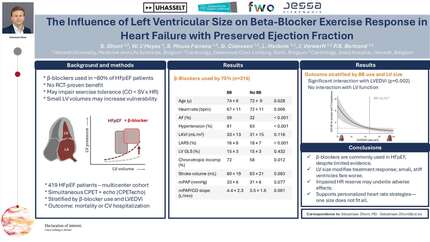
Among 419 patients with HFpEF (mean age 74y, 65% female), 316 (75%) were chronically treated with beta-blockers. Compared to non-users, beta-blocker users were on average older (+2y, p=0.028), exhibited a lower peak heart rate (-5bpm, p<0.001), a reduced peak cardiac index (-0.5 L/min/m2, p<0.001), a steeper mPAP/CO slope (+1 mmHg/L/min, p<0.001), trend towards lower peak VO2 (-1 mL/min/kg, p=0.064) and higher E/e’ ratio (+1, p<0.001), indicating increased LV filling pressures and impaired hemodynamic response during isotonic exercise (Figure 1). Chronotropic incompetence was more prevalent among beta-blocker users (72% vs. 58%, p = 0.012). Beta-blocker use was associated with a higher risk of the composite endpoint (HR 1.76, 95% CI 1.07–2.9, p = 0.027), after adjusting for age and NT-proBNP. A significant interaction with LVEDVi (p = 0.002) indicated that beta-blocker-associated risk increased as LVEDVi decreased, with a threshold of <34.4 mL/m² identified in ROC analysis (Figure 2). Notably, VO₂/CO slope did not significantly differ between groups (5.6 ± 2.9 without vs 5.6 ± 2.4 mL O₂/L CO with beta-blocker, p = 0.949), suggesting that beta-blockers primarily impair cardiac output augmentation rather than peripheral oxygen utilization.
Beta-blockers were linked to impaired exercise response and worse clinical outcomes in HFpEF, particularly in patients with smaller ventricles who rely even more on chronotropic reserve during exertion. These findings underscore the need for a personalized, physiology-driven approach to heart rate modulation in HFpEF. Rest and exercise parameters HR in function of LV indexed volume
Contributors





You may be interested in