Association of ECG abnormalities with heart failure exacerbation in HFimpEF: a multi-center retrospective analysis
European Heart Journal


Abstract
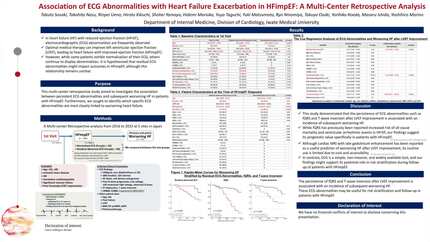
In heart failure with reduced ejection fraction (HFrEF), electrocardiographic (ECG) abnormalities are frequently observed. Optimal medical therapy (OMT) can improve left ventricular ejection fraction (LVEF), leading to heart failure with improved ejection fraction (HFimpEF). However, while some patients exhibit normalization of their ECG, others continue to display abnormalities. It is hypothesized that residual ECG abnormalities might impact outcomes in HFimpEF, although this relationship remains unclear.
This multi-center retrospective study aimed to investigate the association between persistent ECG abnormalities and subsequent heart failure exacerbation in patients with HFimpEF. Furthermore, we sought to identify which specific ECG abnormalities are most closely linked to heart failure deterioration.
From 2016 to 2023, a retrospective multi-center study was conducted among patients with HFimpEF. ECG findings were evaluated at the time of initial presentation, at the confirmation of HFimpEF, and at the time of an exacerbation event. Patients were stratified into two groups based on the presence or absence of persistent ECG abnormalities. The ECG abnormalities assessed included fragmented QRS (fQRS), poor R-wave progression, and T-wave inversion.
A total of 143 HFimpEF patients were enrolled. The mean age at initial diagnosis was 61 years, and 38.2% were female. At the time of initial diagnosis, the median BNP was 649 (399–838) pg/dL, and the median LVEF was 31% (25–33%). At confirmation of HFimpEF, the median BNP decreased to 24 (9–48) pg/dL, and the median LVEF improved to 56% (53–60%). At the time of HFimpEF, the prevalence of ECG abnormalities was 23.8% for fQRS, 30.1% for T-wave inversion, and 22.4% for poor R-wave progression. Heart failure exacerbation occurred in 17.5% of patients. Log-rank testing revealed that patients with persistent fQRS and T-wave inversion experienced a higher incidence of heart failure exacerbation (fQRS: p<0.001; T-wave inversion: p=0.03). In a Cox hazard analysis adjusted for age, sex, LVEF at HFimpEF, and BNP, persistent fQRS and T-wave inversion remained significantly associated with heart failure exacerbation (fQRS: HR 1.48, 95% CI 1.14–2.98; T-wave inversion: HR 1.28, 95% CI 1.03–1.56).
The persistence of fQRS and T-wave inversion after LVEF recovery is associated with an increased risk of heart failure exacerbation. These ECG abnormalities may serve as useful prognostic indicators for risk stratification and follow-up in patients with HFimpEF.



You may be interested in