Impact of previous COVID-19 on functional class and echocardiographic parameters in patients with HFrEF: a retrospective study
European Heart Journal


Abstract
Coronavirus infection (COVID-19) significantly affects the cardiovascular system, leading to myocardial injury, inflammation and endothelial dysfunction. In patients with chronic heart failure (CHF) these changes may worsen clinical status and reduce myocardial contractility.
To evaluate the impact of previous COVID-19 on functional class and echocardiographic parameters in patients with heart failure with reduced ejection fraction (HFrEF).
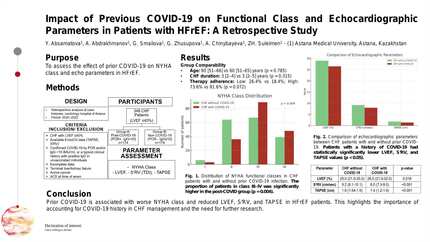
We conducted a retrospective analysis of medical records from 348 patients diagnosed with CHF (left ventricular ejection fraction (LVEF) ≤40%), who were hospitalised in a specialised cardiology centre, between 2020 and 2022. Patients were divided into two groups: those with a history of COVID-19 (PCR-positive, SARS-CoV-2 IgG >10 BAU/mL, n=174) and those without (PCR-negative, SARS-CoV-2 IgG ≤10 BAU/mL, n=174). We assessed the New York Heart Association (NYHA) functional class, LVEF, tissue Doppler imaging of the free right ventricular wall (S'RV) and tricuspid annular plane systolic excursion (TAPSE). For statistical analysis we used the non-parametric Mann-Whitney U test and Pearson’s χ² test for categorical variables.
First, we assessed confounding factors between the groups, including age (p = 0.785), CHF duration (p = 0.315) and adherence to therapy (p = 0.072). Since the groups were comparable, we focused on functional and echocardiographic characteristics. We found that the proportion of patients with NYHA functional class III–IV was 1.3 times higher in the CHF with COVID-19 group, while those with class I–II were 2.5 times more common in the CHF without COVID-19 group (p = 0.004). LVEF was statistically significantly higher in patients without COVID-19 (29% vs 26.5%, p = 0.018). The S'RV was also higher in the non-COVID group (9.2 cm/sec vs 8.0 cm/sec, p < 0.001). Similarly, TAPSE differed statistically significant between the CHF without and with COVID-19 groups (1.8 cm vs 1.4 cm, respectively, p < 0.001).
A history of COVID-19 is associated with a worsening of NYHA functional class, decreased LVEF, S'RV, and TAPSE in patients with HFrEF. These findings highlight the need to consider previous COVID-19 infection when managing CHF patients and underscore the necessity for further research.
Contributors


A Abdrakhmanov
Author
Heart Rhythm Research Institute at Astana Medical University Astana , Kazakhstan

G Zhusupova
Author
Z H Suleimen
Author
You may be interested in