Plasma proteomic profiles of left ventricular diastolic dysfunction differ by sex in a population at risk for cardiovascular disease
European Heart Journal


Abstract
Left ventricular diastolic dysfunction (LVDD) is highly prevalent and is associated with adverse prognosis. While LVDD prevalence is similar between sexes, women more often transition to heart failure with preserved ejection fraction, suggesting sex differences in mechanisms of disease progression. Plasma proteomic profiling may provide novel insights into sex-specific pathways linked to LVDD.
We aimed to (1) identify proteomic correlates of echocardiographic markers of LVDD in adults at high cardiovascular risk and to (2) evaluate clinical risk factors associated with these proteins, focusing on sex differences.
Participants from the HELPFul study (n=580, 65% women) underwent echocardiography and plasma proteomic profiling using the SomaScan V4 assay (4534 proteins). LVDD markers included E′, E/E′ and left atrial volume index (LAVI). We assessed associations between proteins and echocardiographic parameters using linear regression, adjusted for age and sex, with multiple testing correction via the Benjamini-Hochberg procedure. Effect modification by sex was evaluated using interaction terms. We performed sex-stratified analyses, followed by multivariable models assessing risk factor-protein associations. Finally, we applied pathway enrichment analysis to identify biological processes linked to LVDD.
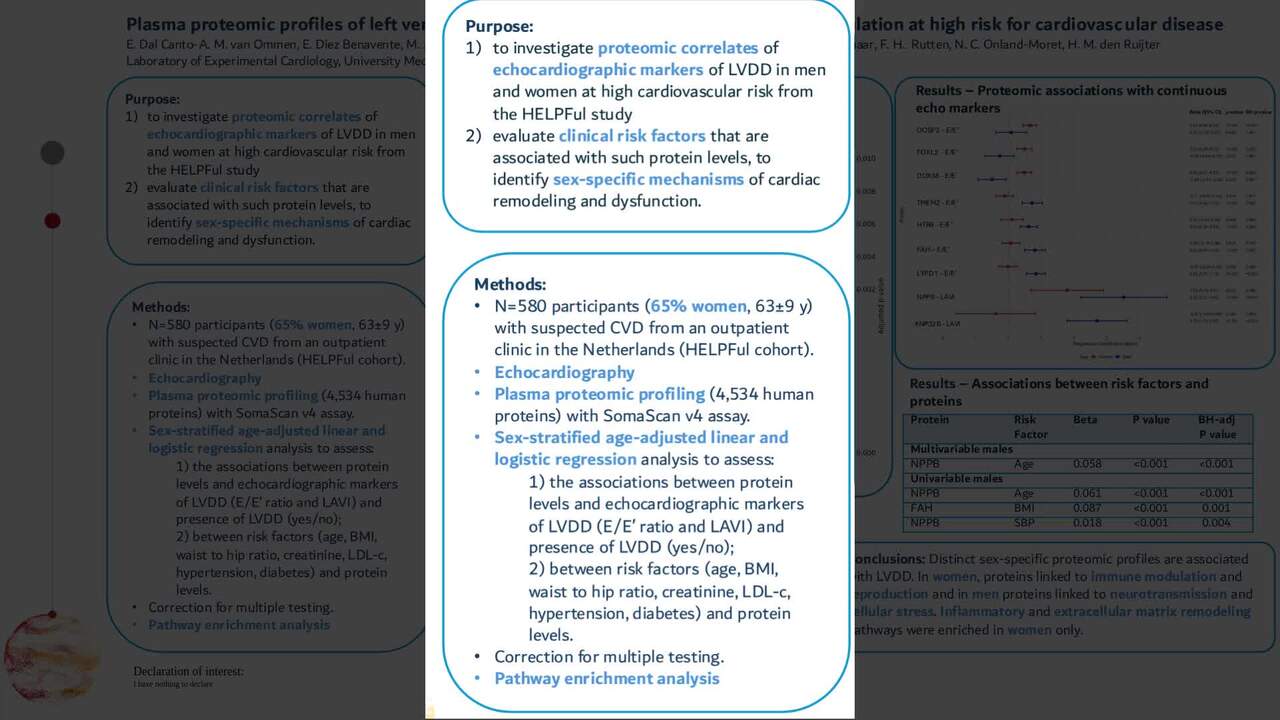
Distinct plasma protein profiles emerged for E/E′ and LAVI in women and men (Figure 1), while no proteins associated to E’. In women, proteins associated with E/E′ included OOSP2 (β=0.67, FDR<0.001), FOXL2 (β=0.50, FDR=0.025), TPPP2 (β=-0.46, FDR=0.001)
and DDX58 (β=0.49, FDR=0.025), suggesting the involvement of reproductive processes and immunity. In contrast, men showed associations with LYPD1 (β=1.07, FDR<0.001), FAH (β=0.95, FDR=0.002), and HTR6 (β=0.88, FDR=0.006), linked with cell adhesion and aminoacid metabolism. In women, A4GALT (β=2.13, FDR =0.098) and NAT14 (β=1.85, FDR=0.098) were associated with LAVI, suggesting roles in glycosylation and metabolic regulation. Men showed association with ANP32B (β=3.58, FDR<0.001) and NPPB (β=4.14, FDR <0.001), related to chromatin remodeling and natriuresis. In women, BMI and age were associated with higher levels of TPPP2 while in men, BMI was associated with higher levels of FAH, highlighting metabolic differences in plasma proteomic signatures. Pathway enrichment (Figure 2) in women for E/E′ showed cytokine production, immune response, and extracellular matrix remodeling. In men we did not observe significant pathways for E/E′. For LAVI, men exhibited immune activation, leukocyte migration, and blood coagulation pathways, whereas women showed lower TGF-beta and BMP signaling.
This study identifies sex-specific plasma proteomic correlates of LVDD and links key proteins to distinct clinical risk factors. These findings highlight potential sex-biased mechanisms underlying LVDD which warrant further validation. Heat map of enriched pathways
Contributors

E Diez Benavente
Author
A J Teske
Author
R Menken
Author
K Taha
Author


M Verhaar
Author


H M Den Ruijter
Author
You may be interested in