Cardiac cGMP augmentation and hemodynamic improvement in heart failure with reduced ejection fraction: evidence from sacubitril/valsartan and vericiguat treatment
European Heart Journal


Abstract
Patients with heart failure (HF) often present with a deficient cyclic guanosine monophosphate (cGMP) state, partly due to increased levels of biologically weak pro-B-type natriuretic peptide (pro-BNP). This imbalance leads to a reduced cGMP-to-BNP (cGMP/BNP) ratio. Modulating cGMP–protein kinase G signaling has become a therapeutic strategy in HF management, with agents as sacubitril/valsartan and vericiguat. However, the relationship between cardiac cGMP augmentation and hemodynamic improvement remains unclear.
This study investigated the association between cardiac cGMP augmentation and hemodynamic responses in patients with HF with reduced ejection fraction (HFrEF), while exploring the relationship between pro-BNP processing and cGMP regulation.
We enrolled 20 control patients without HF or structural heart disease and 15 patients with symptomatic HFrEF (median left ventricular EF: 24.5%). Patients with HF underwent right heart catheterization in a clinically stable phase (Baseline) and two months after initiation of sacubitril/valsartan or vericiguat (Post-med). Blood samples were simultaneously collected from the coronary sinus (CS), artery, and vein to measure cGMP and pro-BNP levels. The percentage of pro-BNP (%pro-BNP) was calculated as: pro-BNP/(pro-BNP + mature BNP) × 100.
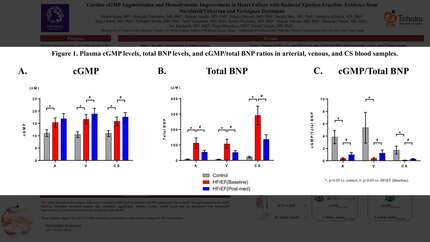
Compared to controls, patients with HF exhibited significantly higher cGMP levels in the CS (15.9±1.6 vs. 10.9±1.2 nM, p<0.01, Figure 1) but a markedly lower cGMP/BNP ratio (0.09±0.02 vs. 1.72±0.63, p<0.01). Following sacubitril/valsartan or vericiguat treatment for HFrEF patients, cGMP levels increased in both the CS and veins (Figure 1). At Baseline, median hemodynamic parameters were as follows: CI, 1.91 L/min/m² (IQR: 1.78–2.24); mean-PAP, 15 mmHg (IQR: 14–19); and PAWP, 9.5 mmHg (IQR: 7.0–11.0). At Post-med, both PAP (13mmHg, IQR 10.5-15.0) and PAWP (6.5 mmHg, IQR 5.3-8.5) were significantly reduced (p<0.05). No significant differences in hemodynamic changes were observed between sacubitril/valsartan (n=6) and vericiguat (n=9). Importantly, %pro-BNP in the CS correlated inversely with CS cGMP levels at Baseline (p=0.025, Figure 2A). The cGMP/BNP ratio in the CS significantly increased from Baseline to Post-med (mean: 0.078 to 0.152), and changes in CS cGMP (ΔcGMP-CS) positively correlated with changes in CI (ΔCI) (p=0.046, Figure 2B).
Cardiac cGMP augmentation, as indicated by elevated CS levels, was associated with hemodynamic improvement in patients with HFrEF. Both sacubitril/valsartan and vericiguat increased cardiac cGMP levels, supporting their therapeutic potential for modulating cGMP pathways. The inverse correlation between %pro-BNP and CS cGMP levels suggests a relationship between impaired pro-BNP processing and cGMP regulation. These findings highlight the potential role of cGMP modulation in optimizing hemodynamics in HFrEF management.
Contributors

H Takahama
Author
H Suzuki
Author
H Hayashi
Author
N Kikuchi
Author
N Yaoita
Author
S Yamamoto
Author

N Minamino
Author
S Yasuda
Author
You may be interested in