Abstract
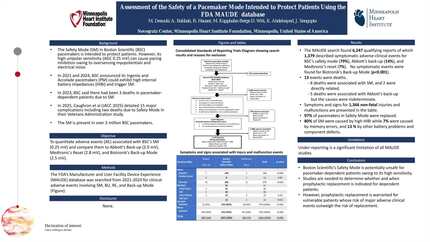
In 2021, Boston Scientific (BSC) announced its Ingenio pacemakers (PM) could exhibit high battery impedances (HBI) and trigger the Safety Mode (SM) that should preserve pacing when PM function is jeopardized. SM is VVI or BiV, 72.5ppm, and sensitivity is unipolar autogain 0.25mV. In 2023, BSC said SM may pause pacing ~ 20 seconds and 3 deaths occurred in pacemaker-dependent patients. In 2024 BSC warned some Accolade PMs had HBI and SM could cause inhibition and life-threatening outcomes.
To quantitate adverse events (AE) associated with SM and compare them to Abbott's Back-up (BU) and Medtronic's Reset (RE) modes.
The FDA’s Manufacturer and User Facility Device Experience (MAUDE) database was searched from 2014-2024 for AE involving SM, BU, and RE (SBR). Major AE included asystole, cardiac arrest, syncope, heart failure, and falls.
We found 2,059 SBR AE, including 6 deaths and 648 major AE; 537 (82.9%) of the major AE were pacemakers in SM vs 80 (12.3%) in BU and 31 (4.8%) in RE (p < 0.001). SM was associated with 354 syncopal events that resulted in head injuries (n=24) or falls (n=26); 71 BU+RE syncopal events resulted in 2 head injuries and 2 falls (p<0.001). Pacing inhibition or oversensing was described for 204 (57.6%) SM syncopal events but none for BU or RE. HBI was the most common but not exclusive cause of SM.
SM is associated with major AEs that are more numerous and serious than BU or RE. Most SM AEs appear related to its high sensitivity and consequently SM may be unsafe for pacemaker-dependent patients.
Contributors

M Kapphahn-Bergs
Author
M Desouki
Author

J Sengupta
Author
Minneapolis Heart Institute and Abbott Northwestern Hospital Minneapolis , United States of America
You may be interested in