Characterizing arrhythmia onset during sleep and activity: insights from long-term continuous monitoring in a large national cohort
European Heart Journal


Abstract
Circadian patterns of arrhythmias have been described only in small datasets. The integration of accelerometer data with ambulatory ECG long-term continuous monitoring (LTCM) may enable additional insights into the relationship between arrhythmia onset and physiological states such as sleep, wake, activity and inactivity.
We investigated the association of arrhythmia onset to periods of sleep, wake, activity and inactivity in patients receiving 14-day LTCM.
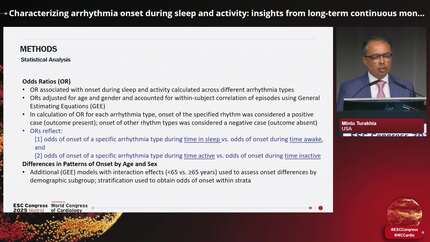
We conducted a retrospective analysis of patients monitored for clinical indications with an FDA-cleared LTCM patch device between August 2023 and July 2024. Patients were randomly sampled and stratified by month. An AI algorithm was developed and validated to classify periods of sleep, wake, activity (≥2mph walking), and inactivity using the accelerometer embedded in the device. Arrhythmia episodes were identified using an FDA-cleared deep learned algorithm, confirmed by an ECG technician, and time-aligned to the sleep/wake and activity/inactivity labels. Odds ratios (OR) associated with arrhythmia onset occurring during sleep and activity periods were calculated by rhythm type, with statistical significance determined using a chi-square test.
The analysis included 23,962 patients with a mean age of 60.9 ± 18.0 years; 57.7% of patients were female. Palpitations were the most common indication for monitoring. Median LTCM wear time was 13.7 days (IQR 7.2-14.0 days). Median percentage of monitoring time spent in sleep and wake were 30.4% (IQR 26.5%-39.4%) and 69.6% (IQR 65.1%-73.5%), respectively. Of wake, the median percent time in activity and inactivity were 2.1% (IQR 0.5%-4.8%) and 97.9% (IQR 95.2%-99.5%). As shown in the Table, arrhythmia onsets having the highest association with sleep were: pause (OR=2.70; 95% CI 2.65-2.76), second degree AVB (Wenckebach; OR=2.20; 95% CI 2.19-2.21) and idioventricular rhythm (OR=1.95 1.91-1.98). Complete heart block (OR=4.55; 95% CI 4.36-4.75), and second degree AVB (Mobitz type 2; OR = 2.26; 95% CI 2.15-2.37) had the highest OR associated with activity. AF onset was more likely to occur in wake than sleep (OR= 0.87; 95% CI 0.86-0.89) and more likely to occur during activity than inactivity (OR=1.52; 95% CI 1.44-1.61).
This is the largest study to define the relationship of arrhythmia onset to sleep, wake, and activity. Results demonstrate the feasibility of integrating sleep and activity labeling with LTCM findings that can give clinical context to arrhythmias to guide risk stratification and further diagnostic testing or therapy.
Contributors


You may be interested in