The impact of screening-detected atrial fibrillation on quality of life
European Heart Journal


Abstract
Screening for atrial fibrillation (AF) may reduce stroke, but the adverse effects are largely unknown.
To investigate how AF detected by screening affected health-related quality of life (HRQoL) compared with AF detected by usual care and to examine HRQoL changes related to stroke and major bleeding.
We used HRQoL data collected from 6004 participants randomised (1:3) to screening for AF with implantable loop recorder and treatment (n=1501) or to usual care (n=4503). HRQoL was measured annually with the EQ-5D-5L questionnaire, which produced a combined EQ-index score (worst=-0.76 best=1.00) and an EQ-VAS score (0=worst, 100=best) for each trial participant per assessment. HRQoL changes were estimated with linear mixed models from before to after incident AF, stroke, and major bleeding, and interaction analyses were performed to assess differences between the randomisation groups. HRQoL changes in event-free participants were estimated from baseline until year three.
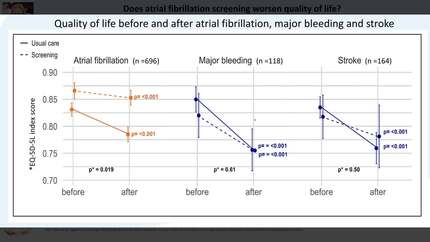
During three years of follow-up, 693 of 6004 (12%) participants were diagnosed with AF (Screening: 424 of 1501 (28%), usual care: 269 of 4503 (6.0%)), and 636 of these were alive at the three-year assessment. HRQoL decreased for all participants during follow-up; For participants developing AF, the EQ-5D-5L index score in the screening group decreased from 0.87 before to 0.85 (p<0.001) after diagnosis, while the score decreased from 0.83 before to 0.79 (p<0.001) after diagnosis in usual care, with less HRQoL decrease in the screening group (p=0.019)(Figure 1). For patients developing stroke, the EQ-5D-5L index score in the screening group decreased from 0.82 before to 0.78 (p<0.001) after diagnosis and from 0.84 before to 0.76 (p<0.001) after diagnosis in usual care. For participants developing major bleeding, the EQ-5D-5L index score in the screening group decreased from 0.82 before to 0.76 (p<0.001) after diagnosis and from 0.85 before to 0.76 (p<0.001) after diagnosis in usual care. The HRQoL reductions following stroke and major bleeding were similar in the two randomisation groups (p=0.50, p=0.61). In event-free participants, the EQ-5D-5L index score decreased from 0.88 to 0.84 (p<0.001) during three years, with no three-year difference between the randomisation groups (p=0.18) (Figure 2). All analyses of EQ-VAS yielded very similar results.
HRQoL was minimally affected by an AF diagnosis detected by screening, compared with a clinical AF diagnosis. Participants diagnosed with stroke and major bleeding had large HRQoL reductions, regardless of the randomisation group.
Contributors




You may be interested in