Prevalence of short PR-intervals and risk of cardiac events and mortality - a nationwide study
European Heart Journal


Abstract
Short PR-intervals without pre-excitation have been associated with increased risk of atrial fibrillation and mortality, but no clinical recommendations exist for this patient group.
To investigate the prevalence of short PR-intervals without preexcitation, defined as PR-interval <120 ms, and its association with clinical endpoints compared to patients with a normal PR-interval in a large, nationwide cohort.
Hospital electrocardiograms (ECGs) (in- and outpatient contacts) from the Danish Nationwide Electrogram Cohort were linked with Danish national registries. Patients with pre-excitation syndromes, congenital heart disease, or pre-existing cardiac device were excluded and ECGs with non-sinus rhythm, heart rate <35 or >110 beats per minute, and recent inflammatory cardiomyopathy were excluded. The prevalence of short PR-interval was reported as absolute and relative frequencies stratified on age and sex. Associations between groups of patients with short PR-interval compared to patients with a normal PR-interval and cardiac events and all-cause mortality were studied using multivariate Cox proportional hazard regressions.
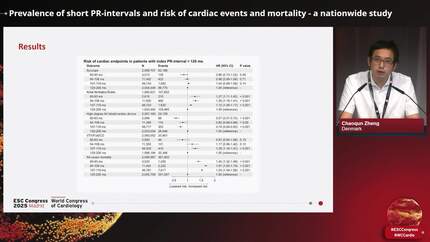
First-time ECGs from 2,234,492 patients (median age 57 years; 53% female) were available for analysis. Median follow-up was 7.1 years. A short PR-interval was found in 64,228 patients (2.9%). The prevalence of a short PR-interval was 1.15-7.97% depending on age and sex with the highest prevalence in the youngest age groups and in females (Figure 1). In Cox models (Figure 2), patients with short PR-intervals had increased hazard ratios (HR) for atrial fibrillation/flutter (80-93 ms: HR 1.27, 95% CI: 1.11-1.45, P<0.001; 94-106 ms: HR 1.29, 95% CI: 1.18-1.41, P<0.001; 107-119 ms: HR 1.12, 95% CI: 1.06-1.17, P<0.001) and all-cause mortality (80-93 ms: HR 1.40, 95% CI: 1.32-1.49, P<0.001; 94-106 ms: HR 1.67, 95% CI: 1.60-1.74, P<0.001; 107-119 ms: HR 1.53, 95% CI: 1.49-1.56, P<0.001). Decreased HR was seen for high-grade atrioventricular block or cardiac device (80-93 ms: HR 0.57, 95% CI: 0.47-0.70, P<0.001; 94-106 ms: HR 0.82, 95% CI: 0.68-0.98, P<0.05; 107-119 ms: HR 0.74, 95% CI: 0.66-0.83, P<0.001), and no difference in risk of syncope (80-93 ms: HR 0.86, 95% CI: 0.73-1.02, P=0.08; 94-106 ms: HR 0.98, 95% CI: 0.89-1.08, P=0.71; 107-119 ms: HR 1.04, 95% CI: 0.99-1.08, P=0.14).
A PR-interval <120 ms was associated with an increased risk of atrial fibrillation/flutter and all-cause mortality, decreased risk of high-degree atrioventricular block or cardiac device and was not associated with risk of syncope. These findings call for studies of mechanisms and identification of means to improve the outcome in patients with PR<120 ms. Prevalence of short PR-interval Risk of events in patients with short PR
Contributors


R Frosted
Author
H S Bosselmann
Author
C Joens
Author
C Polcwiartek
Author
H C Christensen
Author
C Torp-Pedersen
Author
H Bundgaard
Author
A H Christensen
Author
You may be interested in