Safety and performance of a novel defibrillation lead placed in the left bundle branch area: primary results of the LEADR LBBAP clinical trial
European Heart Journal


Abstract
Right ventricular placement of the OmniaSecure defibrillation lead has demonstrated high defibrillation success, low occurrence of lead-related major complications and high predicted reliability. With the advent of left bundle branch area pacing (LBBAP) as a more physiologic option for therapeutic delivery of pacing, LBBAP has emerged as a potentially more desirable option for pacing in the ICD population.
To understand the safety and performance of the OmniaSecure defibrillation lead when placed in the LBBA in ICD and CRT indicated patients.
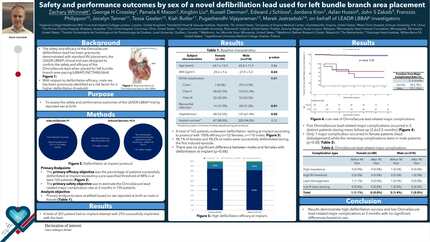
The Lead Evaluation for Defibrillation and Reliability in LBBAP (LEADR LBBAP) clinical trial is a global, prospective, non-randomized, multi-center study to evaluate the OmniaSecure defibrillation lead in the LBBAP position. Enrolled patients are indicated for de novo implantation of a primary or secondary prevention ICD (LBBAP-ICD) or left bundle branch area pacing-optimized CRT-D (LOT-CRT-D). LOT-CRT-D patients required a coronary sinus lead for LV pacing. At least 300 patients are required for enrollment with a minimum of 150 LOT-CRT-D implant attempts. Per study protocol, LBBAP includes deep septal pacing. The primary efficacy objective is defibrillation efficacy at implant exceeding a pre-specified threshold of 88% in at least 160 patients. The defibrillation protocol aligned to standard of care testing with a maximum of six inductions and troubleshooting and/or lead repositioning in-between. Defibrillation success was defined as termination of first sustained shockable ventricular arrhythmia (SSVA) episode with 18J or 10J safety margin or termination of additional induced SSVA episodes with a 10J safety margin. The primary safety objective is to demonstrate the lead-related major complication rate at 3 months post-implant. Database snapshot was February 12, 2025.
As of data snapshot, a total of 191 patients met the criteria for LBBAP implant attempt (age: 66.3±12.0 years; 31.0% female). The physician-reported LBBAP implant success per protocol was 95.8% (n=183; n=104 LBBAP-ICD; n=79 LOT-CRT-D). Defibrillation testing was performed in 162 patients with a protocol success rate of 100%. In 98.1% there was no need for repositioning or troubleshooting as the first induced SSVA was successfully treated. During available follow up (116.7±37.4 days; 62 patients with 3-month follow-up), there was one major lead related complication (high RV threshold) 92 days after implant that resulted in replacement with a non-study lead. There were no lead fractures or deaths related to system and/or procedure.
The LEADR LBBAP clinical trial is the first large clinical trial to prospectively assess the safety and efficacy of a novel defibrillation lead implanted for LBBAP in a large cohort of ICD and CRT-D indicated patients. These results demonstrate procedural-related safety and efficacy of the OmniaSecure lead when placed for LBBAP. Long-term follow-up is ongoing.





You may be interested in