Autonomic dysregulation and HRV surges as precursors to postoperative atrial fibrillation
European Heart Journal


Abstract
Postoperative atrial fibrillation (POAF) is a prevalent complication of cardiac surgery, impacting a significant number of patients. Deciphering the underlying mechanisms and identifying early predictors are essential for effective prevention and management of POAF.
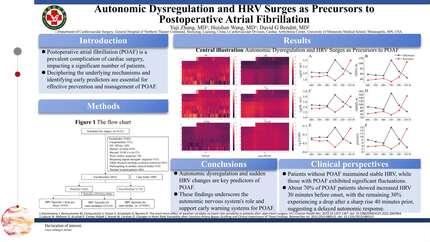
We monitored 2,881 consecutive participants without preoperative atrial fibrillation using a 7-day Holter monitor post-surgery. HRV data were meticulously collected and analyzed to assess autonomic nerve patterns in sinus rhythm. Patients were classified into POAF and non-POAF groups based on the development of POAF. We analyzed the HRV trends over seven days for each group and examined HRV dynamics every ten minutes in the hour leading up to the onset of POAF.
38.25% of patients developed POAF postoperatively. Those without POAF showed stable HRV patterns with a marked increase on the third day post-surgery, suggesting a restoration of postoperative circadian rhythm. Conversely, patients with POAF exhibited significant HRV fluctuations, indicative of a disordered autonomic state. Notably, approximately 70% of the POAF patients showed an upward HRV trend about 30 minutes before the onset of POAF. For the remaining 30% of cases, although HRV began to decrease 30 minutes prior to the onset, this downward trend was preceded by a sharp increase 40 minutes before onset, indicating a complex, delayed autonomic response.
The study identifies autonomic dysregulation and abrupt changes in HRV as key precursors to postoperative atrial fibrillation, emphasizing the critical interplay between autonomic nervous system dynamics and atrial fibrillation post-surgery, providing theoretical support for early warning systems for POAF. The heatmaps of HRV HRV trend immediately before POAF


You may be interested in