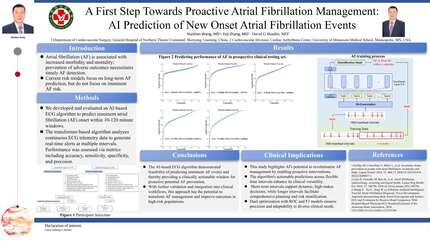
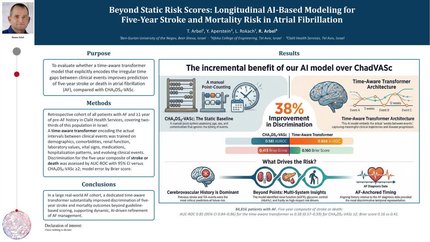
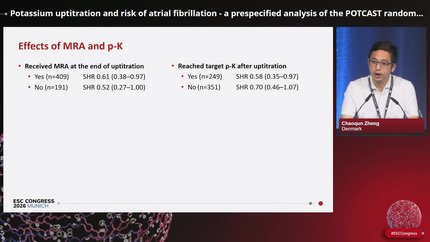
A first step towards proactive atrial fibrillation management using ai prediction in a 10-120 minute window
European Heart Journal


Abstract
Atrial fibrillation (AF) is a common arrhythmia associated with significant morbidity and mortality, necessitating timely detection and intervention. Current risk models focus on long-term prediction, leaving a gap in short-term, real-time AF prediction.
We developed and evaluated an artificial intelligence (AI)-based electrocardiogram (ECG) algorithm capable of predicting imminent AF onset within 10 to 120 minutes. In this prospective observational study, conducted between May 2023 and May 2024, 3,451 patients were enrolled, with 2,780 allocated to training, validation, and testing datasets and 671 to a prospective clinical testing cohort. The algorithm analyzed continuous ECG telemetry data, employing a transformer-based architecture to generate real-time alerts at multiple prediction intervals. Predictive performance was assessed using accuracy, sensitivity, specificity, and other metrics.
Findings
The AI algorithm achieved strong predictive performance, particularly at shorter intervals. In the prospective testing cohort, the 10-minute interval achieved a sensitivity of 69.57%, specificity of 97.50%, and an NPV exceeding 99%. Predictive accuracy declined at longer intervals (e.g., 120 minutes), with sensitivity dropping to 58.27% while maintaining high specificity (87.75%). The ROC and F1 optimization models provided complementary approaches, balancing sensitivity and specificity based on clinical priorities. Integration of additional clinical parameters did not significantly enhance predictive performance.
Interpretation
The AI-based ECG algorithm demonstrated the feasibility of real-time AF prediction, providing a clinically actionable window for proactive management. With further validation and integration into clinical workflows, this approach has the potential to transform AF management and improve outcomes in high-risk populations. Predicting performance of AF AI training process


You may be interested in