CHA2DS2-VASc vs. CHA2DS2-VA regarding their stroke risk stratifications in patients with atrial fibrillation: insights from the GLORIA-AF registry
European Heart Journal


Abstract
Whether the adoption of CHA2DS2-VA score, the sex-independent version of the CHA2DS2-VASc score is beneficial for stratifying risk of stroke in patients with atrial fibrillation (AF) remains controversial.
To compare CHA2DS2-VASc and CHA2DS2-VA in terms of thromboembolic risk stratification.
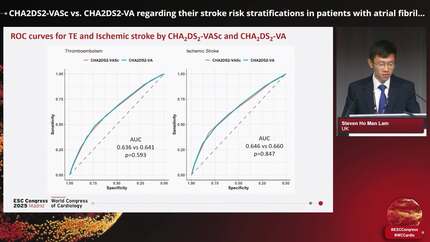
Utilising the data from the global, multicentre and prospective GLORIA-AF Registry Phase III, we compared the performances of CHA2DS2-VA and CHA2DS2-VASc in stratifying the risk of ischemic stroke and thromboembolism (TE) and compared the risk of ischemic stroke and TE, and second, the use of oral anticoagulants between male and female patients with AF.
A total of 21,260 AF patients with available data were included in the analysis (Age: mean ± SD, 70.2±10.3 years, 44.9% Female). Overall, female patients were less likely prescribed with OAC compared to males (OR:0.90, 95%CI: [0.83-0.97]). A significant interaction (p<0.001) between sex and age was observed, with a lower likelihood of receiving OAC among younger female patients (Figure 1).
The risk of ischemic stroke (HR:1.14, 95%CI: [0.85-1.53]) and TE (HR: 1.02, 95%CI: [0.82-1.26]) was similar between male and female patients. The predictive ability of the two scores was similar for both outcomes: TE (AUC:0.641, 95%CI: [0.585-0.697] vs AUC:0.636, 95%CI: [0.580-0.692]; p=0.593) and ischemic stroke (AUC:0.660, [95%CI: 0.582-0.739] vs AUC:0.646, [95%CI: 0.568-0.725]; p=0.847) (Figure 2). There was a possible interaction between sex and age observed, with a higher risk of TE in younger female patients (p=0.051) (Figure 1).
CHA2DS2-VA score had similar overall predictive performance for thromboembolic events compared to CHA2DS2-VASc score. The role of female sex in the management and outcomes of patients with AF may differ according to age, with a higher risk of TE in younger female patients.
Contributors

S H M Lam
Author
University of Liverpool Liverpool , United Kingdom of Great Britain & Northern Ireland

G F Romiti
Author
B Corica
Author
T Bucci
Author

A Askarinejad
Author
Institute of Life Course and Medical Sciences Liverpool , United Kingdom of Great Britain & Northern Ireland


G Y H Lip
Author
University of Liverpool Liverpool , United Kingdom of Great Britain & Northern Ireland
You may be interested in