Stroke risk in low-risk patients with atrial fibrillation on oral anticoagulation therapy: Insights from a Swedish cohort
European Heart Journal


Abstract
While substantial evidence supports the efficacy of oral anticoagulant (OAC) therapy in preventing ischemic stroke (IS) among high-risk patients with atrial fibrillation (AF), data regarding on its benefit in low cardiovascular risk profile patients remain limited. The necessity of OAC in this population is an ongoing subject of debate.
The aim of this study is to examine the incidence of IS in patients with AF on OAC therapy compared to controls of the same age-and sex- on OAC.
This study linked data from Swedish health registers to identify all patients diagnosed with AF but without prior cardiovascular comorbidities between 1987 and 2018. Using the Swedish Prescribed Drug Register, established in July 2005, we identified AF patients receiving OAC therapy between 2006 and 2018. The risk of IS was assessed using Cox regression models, comparing AF patients on OAC with age- and sex-matched controls without AF on OAC.
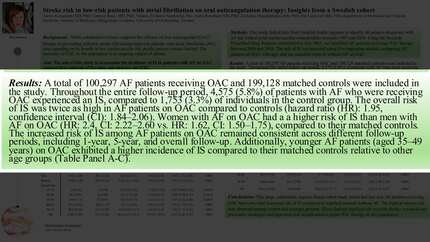
A total of 100,297 AF patients receiving OAC and 199,128 matched controls were included in the study. Throughout the entire follow-up period, 4,575 (5.8%) of patients with AF who were receiving OAC experienced an IS, compared to 1,753 (3.3%) of individuals in the control group. The overall risk of IS was twice as high in AF patients on OAC compared to controls (hazard ratio (HR): 1.95, confidence interval (CI): 1.84–2.06). Women with AF on OAC had a a higher risk of IS than men with AF on OAC (HR: 2.4, CI: 2.22–2.60 vs. HR: 1.62, CI: 1.50–1.75), compared to their matched controls. The increased risk of IS among AF patients on OAC remained consistent across different follow-up periods, including 1-year, 5-year, and overall follow-up. Additionally, younger AF patients (aged 35–49 years) on OAC exhibited a higher incidence of IS compared to their matched controls relative to other age groups (Table Panel A-C).
This large, nationwide, register-based cohort study found that low-risk AF patients receiving OAC had a two-fold increased risk of IS compared to matched controls without AF. The highest relative risk was observed among women and younger patients. These findings highlight the need for further research into preventive strategies and improved risk stratification to guide OAC therapy in this population.
Contributors


C Basic
Author
Institute of Medicine - Sahlgrenska Academy - University of Gothenburg Gothenburg , Sweden

T Zverkova Sandstrom
Author

You may be interested in