Biomarkers of atrial remodelling and risk of cardiovascular death in patients with hypertension: the LOOP study
European Heart Journal


Abstract
Hypertension is associated with changes in biomarkers of atrial remodelling like left atrial (LA) strain, pro-brain natriuretic peptide (pro-BNP), and high-sensitivity C-reactive protein (hsCRP). All of these biomarkers have been associated with unfavorable outcomes such as cardiovascular (CV) death, but the interplay between the biomarkers and risk of outcomes in hypertension is not well addressed.
To investigate the association between biomarkers of atrial remodeling (LA strain (peak atrial contractile strain (PACS) and peak atrial longitudinal strain (PALS)), proBNP, and hsCRP,) and CV death in an older population of hypertensive patients. In addition, we wanted to investigate the interplay between biomarkers regarding the future risk of CV death.
Post-hoc analysis of a randomized clinical trial that investigated whether atrial fibrillation screening, using an implantable loop recorder, and subsequent initiation of anticoagulation, could prevent stroke in high-risk individuals. Individuals with hypertension who had transthoracic echocardiography performed at baseline, were included in this sub-study (n = 1326). Cox proportional hazard regression analysis was performed to investigate the association between risk factors and risk of cardiovascular death. The primary outcome was CV death.
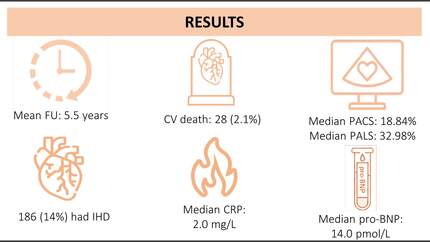
Mean age was 74.3 (+/- 4.0 years), and 53.8% were men, 27.0% had diabetes, 57.9% received statins, and 22.6% had prior stroke or transient ischemic attack. Median hsCRP was 2.0 [IQR: 1.0-4.0]. Median pro-BNP was 14.0 [IQR: 8.0-26.0] (Table 1).
During a median follow-up of 5.5 years 28 (2.1%) suffered CV death. Increasing hsCRP and pro-BNP, decreasing PACS and decreasing PALS were all associated with a higher risk of CV death (P<0.05 for all), in univariable analysis (Figure 1). When adjusting for comorbidities, sex, age, hsCRP/pro-BNP and PACS/PALS, only PACS remained significantly associated with CV death (HR 0.90 [0.81-0.99] p = 0.04) (Fig. 1).
PALS and PACS modified the prognostic value of hsCRP (p for interaction both < 0.001). Stratifying PACS and PALS according to the median values revealed that increasing hsCRP was only associated with CV death for patients with high PACS and high PALS (adjusted HR 1.15 [1.07-1.23] p < 0.001 and HR 1.13 [1.05-1.22] p = 0.002, respectively) (Fig. 1.). When examining the opposite interaction, no effect modification of hsCRP on PALS or PACS was observed. No interaction or modification of pro-BNP was detectable.
This post-hoc analysis of the LOOP study demonstrates that PALS and PACS has a significant effect modification on the prognostic value of hsCRP in relation to CV death. The association between hsCRP and CV death was dependent on preserved LA function.
Contributors



You may be interested in