Redefining the risk of major arrhythmic events in non-ischaemic cardiomyopathy: insights from the DERIVATE-NICM study
European Heart Journal - Cardiovascular Imaging


Abstract
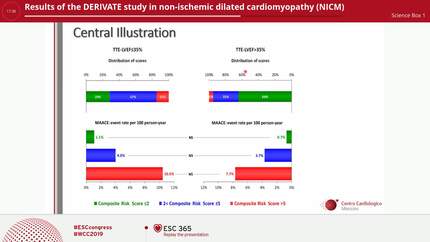
Selection of the patients for implantable cardioverter defibrillator primary prevention therapy in non-ischaemic cardiomyopathy (NICM) needs to be improved. To evaluate the additional prognostic value of a new cardiac magnetic resonance (CMR) score based on late gadolinium enhancement (LGE) pattern distribution (DERIVATE Risk Score 2.0) when compared with previously published DERIVATE Risk Score 1.0, which is based solely on quantitative parameters, in a cohort of NICM patients enrolled in the DERIVATE registry.
One thousand three hundred and eighty-four NICM patients with chronic heart failure and left ventricular ejection fraction (LVEF) < 50% were evaluated for primary sudden cardiac death prevention therapy. Major adverse arrhythmic cardiac events (MAACEs) were the primary endpoint. During a median follow-up of 959 days, MAACE occurred in 128 (9.2%) patients. In the multivariate analyses, male gender [hazard ratio (HR): 1.605 (95% confidence interval, CI: 1.051–2.451);
The presence of midwall LGE, but also the location of scar, confers an added and independent MAACE risk to a large NICM population influencing the choice of treatment.
Contributors

Andrea Igoren Guaricci
Author
Nazario Carrabba
Author
Salvatore Mario Romano
Author
Marco Chiostri
Author

Andrea Baggiano
Author
Saima Mushtaq
Author
Alessandra Volpe
Author
Raffaele Abete
Author
Giovanni Donato Aquaro
Author
Andrea Barison
Author
Paolo Basile
Author
Jan Bogaert
Author
Leonardo Calo’
Author
Giovanni Camastra
Author
Samuela Carigi
Author
Grazia Casavecchia
Author
Stefano Censi
Author
Gloria Cicala
Author
Marco Matteo Ciccone
Author
Carlo N De Cecco
Author
Manuel De Lazzari
Author
Gabriella Di Giovine
Author
Monica Dobrovie
Author
Marta Focardi
Author
Nicola Gaibazzi
Author
Annalaura Gismondi
Author
Matteo Gravina
Author
Marco Guglielmo
Author
Chiara Lanzillo
Author
Massimo Lombardi
Author
Valentina Lorenzoni
Author
Jordi Lozano-Torres
Author

Chiara Martini
Author
Francesca Marzo
Author
Pier-Giorgio Masci
Author
Ambra Masi
Author
Claudio Moro
Author
Giuseppe Muscogiuri
Author
Alberto Nese
Author
Alessandro Palumbo
Author

Patrizia Pedrotti
Author
Martina Perazzolo Marra
Author
Silvia Pradella
Author
Cristina Presicci
Author
Mark G Rabbat
Author
Claudia Raineri
Author
Jose’ F Rodriguez-Palomares
Author
Guillem Casas
Author
Eduardo Rodenas-Alesina
Author
Alessandro Giustiniani
Author
Stefano Sbarbati
Author
U Joseph Schoepf
Author
Angelo Squeri
Author
Nicola Sverzellati
Author
Rolf Symons
Author
Emily Tat
Author
Mauro Timpani
Author
Giancarlo Todiere
Author
Adele Valentini
Author
Akos Varga-Szemes
Author


You may be interested in