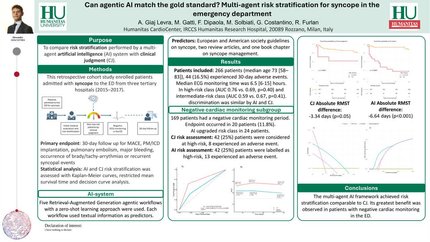
The hope and the hype of artificial intelligence for syncope management
European Heart Journal - Digital Health


Abstract
Syncope remains a diagnostic challenge despite advancements in testing and treatment. Cardiac syncope is an independent predictor of mortality and can be difficult to distinguish from other causes of transient loss of consciousness (TLOC). This paper explores whether artificial intelligence (AI) can improve the evaluation and management of patients with syncope.
We conducted a literature review and incorporated the opinions of experts in the fields of syncope and AI. The cause of TLOC is often unclear, hospitalization criteria are ambiguous, diagnostic tests are frequently non-informative, and assessments are costly. Patients are left with unanswered questions and limited guidance. Artificial intelligence (AI) has the potential to optimize syncope evaluation by processing large data sets, detecting imperceptible patterns, and assisting clinicians. However, AI has limitations, including errors, lack of human empathy, and uncertain clinical utility. Liability issues further complicate its integration. We present three viewpoints: (i) AI is crucial for advancing syncope management; (ii) AI can enhance the patient experience; and (iii) AI in syncope care is inevitable.
Artificial intelligence may improve syncope diagnosis and management, particularly through machine learning–based test interpretation and wearable device data. However, it has yet to surpass human clinical judgment in complex decision-making. Current challenges include gaps in understanding syncope mechanisms, AI interpretability, generalizability, and clinical integration. Standardized diagnostic approaches, real-world validation, and curated data sets are essential for progress. Artificial intelligence may enhance efficiency and communication but raises concerns regarding confidentiality, bias, inequities, and legal implications.
Contributors



Milena A Gebska
Author
Brian Olshansky
Author
Samuel L Johnston
Author
E John Barsotti
Author
Constantinos Bakogiannis
Author


Eric G Heller
Author
Robert S Sheldon
Author

Richard Sutton
Author
Imperial College London London , United Kingdom of Great Britain & Northern Ireland
Mehul Adhaduk
Author
William H Parker
Author
Arwa Aburizik
Author
Corey R Haselton
Author
Alex J Cuskey
Author
Sangil Lee
Author

Donald Macfarlane
Author
Paari Dominic
Author
Haruhiko Abe
Author
B Hygriv Rao
Author
Avinash Mudireddy
Author
Milan Sonka
Author
Roopinder K Sandhu
Author
Rose Anne Kenny
Author
Giselle M Statz
Author

Rakesh Gopinathannair
Author
Kansas City Heart Rhythm Institute Overland Park , United States of America
David Benditt
Author
Franca Dipaola
Author
Mauro Gatti
Author
Roberto Menè
Author
Alessandro Giaj Levra
Author
Dana Shiffer
Author
Giorgio Costantino
Author
Raffaello Furlan
Author
You may be interested in