Arterial stiffness in cancer survivors: the prognostic value of estimated pulse wave velocity (ePWV) in U.S cancer population from NHANES 2009-2018
European Heart Journal Supplements


Abstract
Estimated pulse wave velocity (ePWV), a novel non-invasive marker of arterial stiffness, is strongly associated with cardiovascular (CV) events and all-cause mortality in the general population [1-3]. However, its prognostic potential in cancer survivors remains unexplored. This study evaluates the association of ePWV with all-cause and CV mortality and identifies an optimal ePWV threshold for risk stratification in cancer survivors.
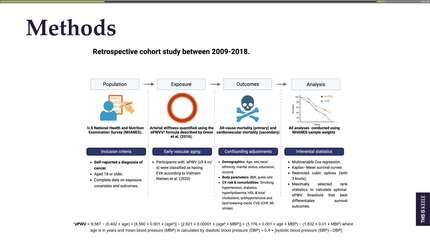
Using 10 years of data from the National Health and Nutrition Examination Survey (NHANES, 2009-2018), we analysed a cohort representing over 105 million U.S. cancer survivors. Multivariate Cox regression and Kaplan-Meier analyses assessed the association between baseline ePWV and mortality, with adjustments for key demographic factors (age, sex, race/ethnicity), socioeconomic variables (income, education, marital status), body parameters (body mass index and pulse rate), traditional CV risk factors (hypertension, diabetes mellitus, hyperlipidemia, smoking history), and baseline CV disease status (heart failure, myocardial infarction, stroke). Dose-dependent relationships were explored using restricted cubic splines, and an optimal ePWV threshold was determined through maximally selected rank statistics.
A total of 105,869,670 weighted cancer survivors (2,234 unweighted) were analysed, recording 435 all-cause and 91 CV deaths, equating to 14,979,486 weighted all-cause deaths and 3,174,609 weighted cardiovascular deaths, respectively. Early vascular aging (EVA, ePWV ≥9.4 m/s) was present in 54.6% of participants, with rectal cancer survivors showing the highest prevalence (88.3%), followed by prostate (80.2%) and bladder (78.6%) cancers. Each 1 m/s increase in ePWV was associated with higher risks of all-cause mortality (29%) and CV mortality (46%) (aHR, 95% CI of 1.29 [1.19–1.40] and 1.46 [1.20–1.76], respectively, both p < 0.001). Those with ePWV ≥ 12.05 m/s demonstrated significantly higher risks of all-cause and CV mortality (aHR, 95% CI of 1.70 [1.35–2.13] and 2.53 [1.56–4.12], respectively, both p < 0.001).
Arterial stiffness, assessed by ePWV, demonstrates prognostic utility in cancer survivors, showing a positive, non-linear association with long-term all-cause and CV mortality, independent of demographic, socioeconomic, traditional CV risk factors, and baseline CV disease status.
Contributors

M Al-Jarshawi
Author
Keele University Stoke-on-Trent , United Kingdom of Great Britain & Northern Ireland



C Diaz-Arocutipa
Author
O Kobo
Author

You may be interested in