Anthropometric and cardiometabolic evolution during DIABEPIC 2 pilot study: type 2 diabetes remission program designed for cardiovascular prevention
European Journal of Preventive Cardiology


Abstract
The most studied strategies for type 2 diabetes (T2D) remission are bariatric surgery and continuous low-calorie diet. DIABÉPIC 2 pilot study demonstrated the feasibility of a T2D remission program based on nutritional and training interventions with known cardiovascular benefits. Thirteen of the 34 diabetics who completed the program were treatment-free at 6 months with an Hb1Ac < 6.5% (Remission group). In contrast, the other 21 diabetics did not reach the criteria of T2D remission (No remission group).
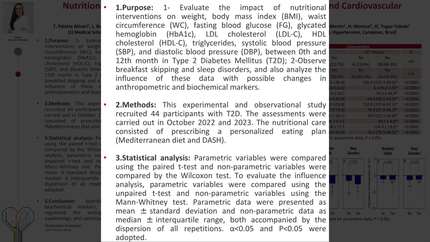
Evaluate exploratory cardiovascular (CV) risk reduction and the change in anthropometric and cardiometabolic values, for the whole sample and between the remission and no remission groups.
TD2 adults were recruited (Hb1Ac > 6.5% or on oral glucose-lowering agents). Interventions involved dietary education (ultra-processed food withdrawal, Mediterranean diet moderate in carbohydrates) and aerobic and strength training. Participants were also randomized (2:1) to an intermittent fasting protocol (figure 1). Bioimpedance analysis (Seca mBCA 514) and blood tests were performed prior to and at the end of the program. A multivariate repeated-measure ANOVA was used to assess group differences, regarding the change in all anthropometric and cardiometabolic markers presented. Exploratory one-way repeated-measures ANOVAs were used to compare pre-post differences. All effect sizes are reported using the partial Eta-squared.
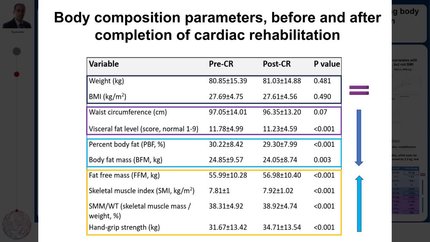
34 participants (41.2% women, 63.6 ± 9.2 years old, T2D duration 7.4 ± 6.7 years, Hb1Ac 6.7 ± 0.7 %). The multivariate analysis showed a group effect (remission vs. no remission) only in the change in triglycerides (TG) (p=0.015, h2p = 0.171). The exploratory analysis in the whole sample (n=34), showed a significant improvement in all anthropometric values: weight -6.8 kg (-9.3 to -4.4, p<0.001), waist -7.5 cm (-9.4 to -5.5, p<0.001), visceral fat -1.3 liters (-1.8 to -0.9, p<0.001), fat mass -3.7% (-4.9 to -2.5, p<0.001), lean mass +3.7% (2.5 to 4.9, 0<0.001). For cardiometabolic parameters, there was a significant change in TG -0.3mmo/l (-0.5 to -0.1, p=0.002), alanine transaminase -7.5 U/L (-14.7 to -0.3, p=0.012), C-reactive protein-high sensibility -1.1 mg/L (-2.0 to -0.2, p=0.004), high-density lipoprotein cholesterol (HDL-C) +0.1 (-0.0 to 0.2, p=0.020), low-density lipoprotein cholesterol +0.2 (-0.0 to 0.4, p=0.036) and TG/HDL-C ratio -0.3 (-0.4 to -0.1, p=0.002), (figure 2 for complete results).
The difference in the evolution of anthropometric and cardiometabolic parameters between the remission and no remission groups was significant only for the TGs, underlining the magnitude of improvements even in the group that did not achieve T2D remission. In addition to the current T2D remission criteria, the CV risk reduction efficacy of selected interventions should be considered in program design. Larger clinical studies are needed to confirm these results. . Interventions. . Results.
Contributors


J Iglesies-Grau
Author

M Gayda
Author
V Pelletier
Author
A Debray
Author
A Nigam
Author
P L'allier
Author
F Simard
Author
L Bherer
Author
You may be interested in