Effect of exercise training on cardiac reserve in heart failure with preserved ejection fraction: a substudy from OptimEx-CLIN
European Journal of Preventive Cardiology


Abstract
Supervised exercise training improves aerobic capacity (V̇O2peak) in patients with heart failure and preserved ejection fraction (HFpEF), but underlying mechanisms remain unclear. We aimed to evaluate whether exercise training could improve parameters of systolic and diastolic function assessed during exercise echocardiography.
This was a substudy of the multicentre Optimizing Exercise Training in HFpEF (OptimEx-Clin) trial, in which patients with HFpEF were randomized 1:1:1 to guideline control, moderate continuous training, or high intensity interval training. All patients included at 2 centres had exercise echocardiography at baseline and 3 months and were included (n=61).
During baseline exercise echocardiography, E/e’ increased to 19.5 ±6.1 and systolic pulmonary artery pressure (PAPs) to 51 ±11 mmHg (both p<.001). Right ventricular function failed to improve (maximal tricuspid annular plane systolic excursion [TAPSE] 24.7 ±4.0 mm, p=.051 vs baseline; maximal TAPSE/PAPs 0.49 ±0.14 mm/mmHg, p<.001 for decrease vs baseline).
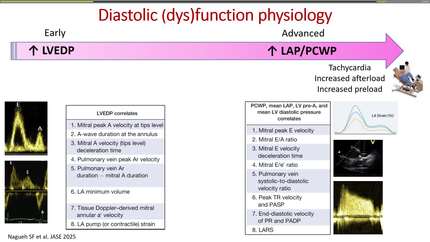
At 3 months, patients randomized to exercise training improved V̇O2peak, and demonstrated small but significant improvements in exercise E/e’ (control 21.7 ± 7.4, training 17.2 ±4.1, p-interaction=.044, Figure) and septal S’ reserve (control 27 ±22 % increase, training 36 ±38 % increase, p-interaction=.034). Echocardiographic changes were not significantly associated with V̇O2peak or training response.
In patients with HFpEF, exercise echocardiography reveals increases in filling pressures during exercise as well as impaired right ventricular reserve. After 3 months of exercise training, HFpEF patients demonstrate small improvements in diastolic reserve (exercise E/e’) and systolic reserve (exercise S’), but these do not explain the improved aerobic capacity. Figure
Contributors


E B Winzer
Author

S De Schutter
Author
P J Beckers
Author
J Hommel
Author
V Adams
Author
B Pieske
Author


C M Van De Heyning
Author
You may be interested in