Proenkephalin improves cardio-renal risk prediction in acute coronary syndromes: the KID-ACS score
European Heart Journal


Abstract
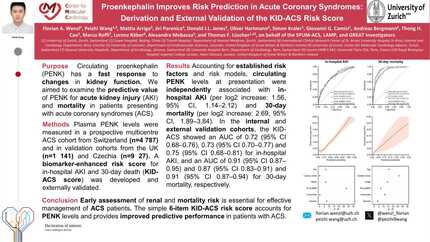
Circulating proenkephalin (PENK) is a stable endogenous polypeptide with fast response to glomerular dysfunction and tubular damage. This study examined the predictive value of PENK for renal outcomes and mortality in patients with acute coronary syndrome (ACS).
Proenkephalin was measured in plasma in a prospective multicentre ACS cohort from Switzerland (
On multivariable adjustment for established risk factors, circulating PENK remained associated with in-hospital AKI [per log2 increase: adjusted odds ratio 1.53, 95% confidence interval (CI) 1.13–2.09,
Circulating PENK offers incremental value for predicting in-hospital AKI and mortality in ACS. The simple six-item KID-ACS risk score integrates PENK and provides a novel tool for simultaneous assessment of renal and mortality risk in patients with ACS.
Contributors



Mattia Arrigo
Author
Jiri Parenica
Author
Donald J L Jones
Author
Francesco Bruno
Author
Daniel Tarnowski
Author
Oliver Hartmann
Author
Lubos Boucek
Author
Fabian Lang
Author
Slayman Obeid
Author
Andreas Schober
Author


Florian Kahles
Author
Alexander Schober
Author
Kok Weng Ow
Author
Stefano Ministrini
Author
Giovanni G Camici
Author
Andreas Bergmann
Author
Luca Liberale
Author
Jiri Jarkovsky
Author
Victor Schweiger
Author
Jatinderpal K Sandhu
Author
Arnold von Eckardstein
Author
Christian Templin
Author
Olivier Muller
Author
Tomas Ondrus
Author
Janet-Jacqueline Olic
Author

Lorenz Räber
Author
Thong H Cao
Author
Carsten G Jungbauer
Author
Leong L Ng
Author
Alexandre Mebazaa
Author

Thomas F Lüscher
Author
Royal Brompton and Harefield NHS Foundation Trust London , United Kingdom of Great Britain & Northern Ireland
You may be interested in