Home alone on milrinone: a novel way to deliver home inotropes as a bridge to heart transplantation
European Heart Journal


Abstract
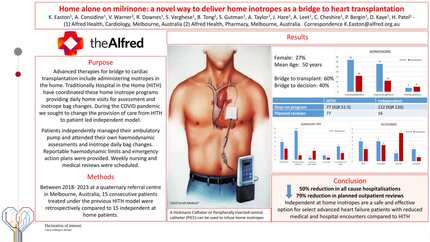
Continuous ambulatory intravenous inotropes can be successfully used as a bridge to decision or heart transplant in patients with end-stage heart failure. The traditional model at our institute involved the Hospital in the Home (HITH) team, with daily nurse-led visits to the patients’ home, to safely maintain this treatment, which is otherwise largely restricted to the intensive care setting. In response to the COVID-19 pandemic, delivery of healthcare underwent a paradigm shift. Our model was changed to a patient led continuous intravenous inotrope program at home which obviated the need for a daily nurse visit. We describe our process and our early outcomes.
Fifteen patients were deemed suitable for the Independent at Home program. All patients needed to complete ambulatory intravenous inotrope education, pass competency testing and have implantable cardioverter-defibrillators inserted prior to discharge. Competencies included proficiency for troubleshooting the inotrope ambulatory delivery pump, monitoring of vital signs and ability to report decompensated heart failure symptoms.
Weekly outpatient visits to our heart failure clinic with nursing, medical and pharmacy reviews were scheduled. Emergency action plans were provided to patients.
73.3% of our cohort were male. The average age was 51 years. 46.6% had a diagnosis of dilated cardiomyopathy. 53.3% were listed for heart transplant and were bridge to transplant (BTT) and 46.7% were bridge to decision (BTD) for heart transplant. Over a study period of 35 months, seven (46.7%) patients were weaned off inotropes, three (20.0%) were escalated to durable mechanical circulatory support (one due to decompensated heart failure and two due to persistently elevated pulmonary pressures), four (26.7%) were transplanted and one (6.7%) chose to be palliated. Six patients had one admission, five patients had two admissions. Five readmissions were due to decompensated heart failure, four admissions were planned to optimize pulmonary hypertension following a right heart catheterization, three had peripherally inserted central catheter (PICC) line complications and two had non-cardiac admissions (refer to table 1). The median length of days on the Independent at Home program was 112 days with an interquartile range of 120 days. A comparative group consisting of consecutive patients treated under the previous Hospital in the Home model are presented in table 2; the Independent at Home cohort shows reduced unplanned admissions. The independent at home inotrope program is an effective and safe option to bridge to decision or bridge to cardiac transplantation. HITH vs Independent admission reason HITH vs Independent admissions
Contributors


A Considine
Author
S Varghese
Author
B Tong
Author
S Gutman
Author
C Cheshire
Author
D Kaye
Author
H Patel
Author
You may be interested in