Age-predicted maximal heart rate reserve as an alternative prognostic parameter in patients with heart failure with preserved ejection fraction -insights from PURSUIT-HFpEF registry-
European Heart Journal


Abstract
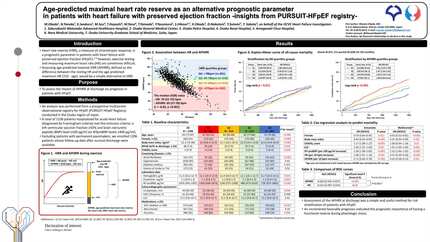
Heart rate reserve (HRR), a measure of chronotropic response, is a prognostic parameter in patients with heart failure with preserved ejection fraction (HFpEF). However, exercise testing and measuring maximum heart rate (HR) are sometimes difficult in patients with heart failure with preserved ejection fraction (HFpEF). Assessing age-predicted maximal HRR (APHRR), defined as the difference between the resting HR and the age-predicted maximum HR (220 - age), would be a simple alternative to HRR.
To assess the impact of APHRR at discharge on prognosis in patients with HFpEF.
An analysis was performed from a prospective multicenter observational registry for HFpEF (PURSUIT-HFpEF Registry) conducted in the Osaka region of Japan. A total of 1231 patients hospitalized for acute heart failure (diagnosed by using Framingham criteria) met the inclusion criteria: a left ventricular ejection fraction ≥50% and brain natriuretic peptide level ≥100 pg/ml. Excluding patients with permanent pacemakers, we enrolled 918 patients (age, 81 ± 9 years; men, 45%; atrial fibrillation, 38%) whose follow-up data after survival discharge were available.
There was a moderate correlation between HR (median 69, interquartile range [IQR] 61-79 beats per minute [bpm]) and APHRR at discharge (71, 59-81 bpm) (r² = 0.68, p <0.001). During the median follow-up period of 23.8 months [IQR, 12.5-36.3] after discharge, 267 patients (15.4%) died, and the mortality rates incrementally decreased according to the APHRR quartiles (Q1, 44.6%; Q2, 26.6%; Q3, 26.2%; Q4, 18.4%; p <0.001). Cox regression analysis revealed that both the resting HR (hazard ratio per quartile increase, 1.16; 95% confidence interval, 1.04-1.30, p = 0.008) and APHRR (0.67; 0.60-0.75, p <0.001) were associated with mortality. However, the diagnostic accuracy was significantly superior in the APHRR than in resting HR (area under the curve; 0.628 vs. 0.552, p <0.001).
Assessment of the APHRR at discharge was a simple and useful method for risk stratification of patients with HFpEF. An incremental favorable prognosis indicated the prognostic importance of having a functional reserve during physiologic stress.
Contributors



K Iwakura
Author
R Hayashi
Author
A Nakagawa
Author
Y Nakagawa
Author
Y Yasumura
Author
S Hikoso
Author
K Okada
Author
Y Sotomi
Author

You may be interested in