Proteomic biomarkers and biological mechanisms associated with atrial fibrillation in heart failure patients
European Heart Journal


Abstract
Atrial fibrillation (AF) and heart failure (HF) are intertwined conditions with high mortality rates and large impact on quality of life, and their coexistence is increasingly prevalent. Both conditions influence each other’s development and progression, and share many risk-factors—such as hypertension, obesity, diabetes mellitus and ischaemic heart disease. Moreover, their combined presence further increases the risk of hospitalization and mortality. The biological mechanisms at play in HF patients with AF may therefore differ from those in HF patients without AF.
We aimed to describe the differences in pathophysiological pathways in HF patients with versus without AF, by identifying biomarkers associated with AF from a panel of 4210 circulating proteins and subsequently examining biological mechanisms related to these biomarkers.
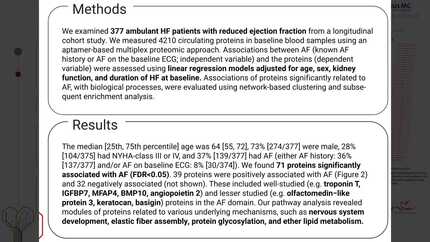
We examined 377 ambulant HF patients with reduced ejection fraction from a longitudinal cohort study. We measured 4210 circulating proteins in baseline blood samples using an aptamer-based multiplex proteomic approach. Associations between AF (known AF history or AF on the baseline ECG) and the proteins were assessed using linear regression models adjusted for age, sex, kidney function and duration of HF at baseline. Associations of proteins significantly related to AF, with biological processes, were assessed using network-based clustering and subsequent enrichment analysis.
The median [25th, 75th percentile] age was 64 [55, 72], 73% [274/377] were male, 28% [104/375] had NYHA-class III or IV, and 37% [139/377] had AF (either AF history: 36% [137/377] or AF on baseline ECG: 8% [30/374]). We found 71 proteins significantly associated with AF (FDR<0.05), including well-studied (e.g. troponin T, IGFBP7, MFAP4, BMP10, angiopoietin 2) and lesser studied (e.g. olfactomedin−like protein 3, keratocan, basigin) proteins in the AF domain. Our pathway analysis revealed clusters of proteins related to various underlying mechanisms, such as axon guidance, elastic fibre assembly, macrophage derived foam cell differentiation, ether lipid metabolism and amyloid-beta binding. Overviews of the significantly associated proteins and related biological mechanisms are provided in Figures 1 and 2.
HF patients with AF have distinct proteomic profiles and these differences are related to various biological mechanisms, many of which can be associated with atrial remodelling. This study provides an overview of the biological mechanisms behind AF in HF, confirms prior findings regarding AF-related proteins, and could guide future research in novel treatment targets and HF-AF management. Proteins associated with AF Biological mechanisms
Contributors



You may be interested in